
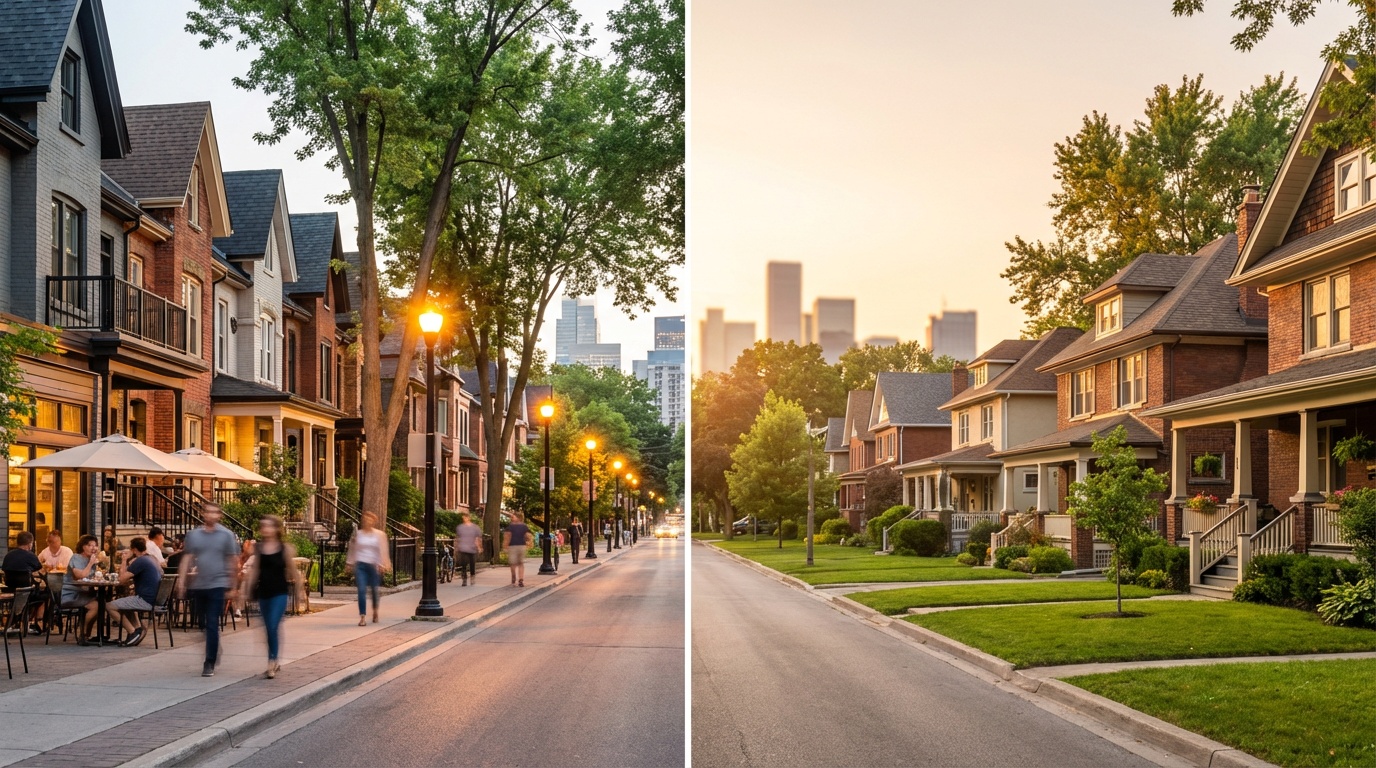
What Is It Like Living on Cleveland's East Side vs. West Side?
TL;DR
- Cleveland's East Side and West Side offer genuinely different lifestyles, cultures, and price points for residents and newcomers.
- Higher-income households are concentrated more heavily on the West Side, while the East Side hosts a larger share of lower-income households, according to Community Solutions research.
- The West Side leans toward breweries, walkable neighborhoods, and strong arts scenes; the East Side offers rich cultural heritage, diverse dining, and more affordable entry-level housing in many areas.
- Suburban home prices range from roughly $380K to $610K on the West Side and $450K to $520K on the East Side, depending on the community.
- Practical factors like highway access, terrain, and even snowfall patterns differ meaningfully between the two sides.
- School district quality varies significantly across both sides, making it a key factor for families evaluating neighborhoods.
- The Young Team helps buyers and sellers navigate both sides of Cleveland with local expertise, trusted programs, and a proven track record.
Introduction
If you've ever mentioned you're moving to Cleveland, one of the first questions you'll hear from locals is simple: "East Side or West Side?" It's a question that carries real weight here. This isn't just a geographic divide on a map. It's a cultural identity, a lifestyle preference, and a financial reality that shapes everything from where you grab coffee on a Sunday morning to what your commute looks like and what your neighbors believe makes a great neighborhood.
Cleveland's East Side and West Side have distinct personalities, and understanding those differences is essential before you buy or rent a home here. Whether you're relocating from out of state, moving within Northeast Ohio, or simply trying to figure out which side of the Cuyahoga River fits your life, this guide gives you an honest, grounded look at both.
In 2026, Cleveland continues to evolve as an affordable, culturally rich metro area in a region that's attracting remote workers, young professionals, and growing families. Knowing which side suits your needs could be the most important research you do before signing anything.
The Income and Economic Reality: Where Households Land
One of the clearest ways to understand the East Side vs. West Side divide is to look at the economics. Research from Community Solutions offers a striking visualization: if Cleveland's higher-income and lower-income households were each represented by just 100 households, roughly 60 of the higher-income households would live on the West Side, while roughly 60 of the lower-income households would live on the East Side.
Community Solutions is a well-respected regional policy organization focused on data-driven solutions for Northeast Ohio communities. Their framing here isn't meant to stigmatize either side. It reflects decades of structural investment patterns, redlining history, and uneven economic development that have shaped where wealth and poverty concentrate in Cleveland.
This context matters for prospective residents. It means housing affordability is generally more accessible on the East Side in many neighborhoods, while the West Side includes areas where rising demand has pushed prices up considerably. It also means that services, school funding, and neighborhood infrastructure can look quite different depending on which side of the river you land on.
The Lifestyle and Daily Experience: More Than Just a River
Ask longtime Clevelanders what separates the two sides, and you won't get a spreadsheet. You'll get stories. News Talk Cleveland's roundup of local perspectives captures something true: the West Side tends to identify with its brewery culture, walkable urban neighborhoods like Ohio City and Tremont, a strong arts community, and a growing food scene that draws national attention. The East Side, by contrast, is celebrated for its deep cultural roots, including Little Italy, Coventry Village, and the Shaker Heights arts corridor, alongside some of the city's most respected delis, Eastern European bakeries, and international dining options.
West Side: Walkability and the Brewery Belt
West Siders often pride themselves on neighborhood connectivity. Ohio City, Detroit Shoreway, and Tremont are designed in ways that encourage walking, biking, and lingering at local businesses. The West Side Market, a Cleveland institution, anchors the Ohio City neighborhood and draws residents who appreciate fresh, local food culture.
The brewery scene is real and dense here. Great Lakes Brewing Company, one of the most recognizable craft breweries in the Midwest, calls Ohio City home. For residents who value that kind of social infrastructure, the West Side delivers consistently.
East Side: Culture, History, and Green Space
The East Side carries a different kind of weight. University Circle is home to the Cleveland Museum of Art (free admission, always), the Natural History Museum, and Severance Music Center. For residents who prioritize proximity to cultural institutions, academic energy, and major green spaces like Rockefeller Park and the Cleveland Cultural Gardens, the East Side is genuinely hard to beat.
The East Side also benefits from neighborhoods like Shaker Heights, which combines historic architecture, tree-lined boulevards, and a diverse, engaged community with strong civic identity. Coventry Village in Cleveland Heights offers an indie bookstore vibe, live music, and a walkable commercial strip that feels distinct from anything on the West Side.
Practical Considerations: What Life Actually Feels Like Day to Day
Beyond culture, there are practical differences that matter when you're making a housing decision. A 2025 video breakdown on YouTube covers several of these clearly.
Terrain and Geography
The West Side of Cleveland tends to be flatter, which has real implications for commuting, biking, and even how neighborhoods feel when you walk them. The East Side features more varied terrain, with ravines, hills, and the distinctive topography of communities like Cleveland Heights and Shaker Heights. If you've ever driven up Fairmount Boulevard in winter, you know the East Side has some elevation to reckon with.
Snowfall Differences
Cleveland's notorious lake-effect snow doesn't fall evenly. The East Side of Greater Cleveland, particularly communities farther east along Lake Erie and into Lake County, can receive significantly more snowfall due to snow belt geography. If you're moving from a region where snow is not a regular part of life, this is a real factor worth researching before choosing your specific neighborhood.
Highway Access
West Side commuters generally have strong access to I-90 and I-71, which connect quickly to Downtown Cleveland and points west. East Side residents lean on I-90, I-271, and I-480, with access patterns that vary depending on how far east you're located. If your work or travel patterns take you south or east regularly, the East Side highway grid may actually be more convenient.
Public Transit Usage
The Red Line rapid transit connects both sides of the city to Downtown and Hopkins Airport, and it remains one of the more useful transit assets in the region. East Side neighborhoods near the rapid transit stops tend to see higher transit usage, particularly among residents in Cleveland, Cleveland Heights, and along the University Circle corridor.
Suburbs Comparison: Schools, Home Prices, and Investment Value
For families and buyers focused on long-term value, the suburban picture on both sides deserves serious attention. Data from NEO Trans provides concrete comparisons that are useful for budgeting and prioritization.
East Side Suburbs: Price Range and School Ratings
East Side suburbs like Beachwood, Solon, and Orange tend to cluster in the approximately $450K to $520K median home price range. These communities are known for consistently high school ratings and strong community investment in education. Beachwood in particular has a national reputation for school quality relative to its size. For buyers with school-age children where academic performance is a primary filter, several East Side communities rank at the top of regional lists.
West Side Suburbs: Wider Range, More Options
The West Side suburbs show more variation in pricing, ranging from approximately $380K at the more affordable end up to $610K in communities like Westlake and Bay Village. This broader range means buyers with different budget constraints can find entry points more easily on the West Side. Rocky River and North Olmsted offer strong school systems at prices that tend to be somewhat more accessible than comparable East Side options.
What This Means for Buyers
Neither side is uniformly more expensive or more valuable. Your budget, commute needs, school priorities, and lifestyle preferences should drive the comparison. A family that wants walkable suburban character with waterfront access might find Lakewood or Rocky River on the West Side hard to beat. A family that prioritizes school ratings and neighborhood stability above all else might find Solon or Beachwood worth stretching the budget.
Demographic Context: Diversity and Neighborhood Evolution
The Cleveland City Planning Commission's demographic data confirms what residents already know from daily experience: Cleveland is a majority-minority city with significant neighborhood-level diversity across both sides. The East Side historically has been home to large African American, Hispanic, and immigrant communities, while the West Side has a long history of Central and Eastern European heritage alongside growing Latino communities, particularly in neighborhoods like Clark-Fulton and Tremont.
These demographic patterns are continuing to evolve. As News Talk Cleveland notes, both sides of Cleveland are experiencing ongoing cultural change as new residents arrive, housing demand shifts, and longtime communities assert their identity. Prospective residents who value neighborhood diversity should look closely at specific communities on both sides rather than making broad assumptions.
Local Market Insights for 2026
In 2026, Cleveland continues to be one of the most affordable major metros in the Midwest, but affordability is increasingly neighborhood-specific. The combination of remote work flexibility and low entry-level prices has sustained buyer interest from out-of-state relocators, particularly from higher-cost cities in the Northeast and Mid-Atlantic.
Both East and West Side neighborhoods are seeing competitive activity in the $250K to $400K range. Entry-level inventory remains tight across the metro. Buyers who come in pre-approved and prepared to move quickly are consistently better positioned. If you're comparing two or three specific communities across the East-West divide, working with a team that knows both sides intimately is genuinely useful, not just a sales pitch.
Why Choose The Young Team
The Young Team is the number one real estate team in Ohio and a top-ranked team within Keller Williams Greater Metropolitan. They serve buyers and sellers across Greater Cleveland, including communities on both the East Side and West Side of the metro.
Their mission is to help clients make confident real estate decisions through honest guidance, creative solutions, and genuine long-term care. The team's approach centers on three core differentiators: Creative Programs that open doors for buyers and sellers who face common obstacles, a Trusted Brand built on years of consistent performance and community relationships, and Forever Client Care that doesn't end at the closing table.
For sellers, The Young Team offers the Worry-Free Listing program, designed to reduce the stress of preparing a home for market, and the Guaranteed Cash Offer program, which gives sellers a reliable exit option without the uncertainty of waiting for the right buyer. These programs are particularly valuable in a market where pricing strategy and timing directly affect net proceeds.
The team's production numbers and client outcomes speak for themselves, with a track record that has established them as the most recognized real estate team in the state. Whether you're buying your first home in Lakewood, selling a property in Beachwood, or exploring options in Shaker Heights or Bay Village, The Young Team brings the local knowledge and support systems that make a meaningful difference.
Frequently Asked Questions
Is the East Side or West Side of Cleveland safer?
Safety varies significantly by specific neighborhood on both sides of the city. Broad generalizations about either side don't hold up well against the actual data. Suburban communities like Solon, Westlake, and Bay Village consistently report very low crime rates regardless of which side of the metro they're on. Within the city of Cleveland itself, safety profiles shift block by block, and buyers should research specific addresses using current local crime data rather than relying on side-of-the-city assumptions.
Which side of Cleveland is better for young professionals?
It depends on your lifestyle preferences. West Side neighborhoods like Ohio City, Tremont, and Lakewood tend to attract young professionals who want walkability, nightlife, and proximity to the brewery and restaurant scene. East Side neighborhoods like Cleveland Heights, Coventry Village, and University Circle appeal to those who value cultural institutions, green space, and a slightly quieter but still engaged community vibe. Both offer reasonably priced housing compared to peer metros.
Are East Side schools better than West Side schools?
School quality varies widely on both sides. Several East Side suburban districts, including Beachwood, Orange, and Solon, rank among the highest in the state. West Side suburban districts like Rocky River and Westlake also perform well and offer strong programs. Within the Cleveland Metropolitan School District, which spans both sides of the city, there is significant variation by school. Families should research specific schools at their target address rather than treating either side as uniformly stronger.
How different are home prices between the two sides?
According to data from NEO Trans, East Side suburbs tend to cluster in a narrower median range of around $450K to $520K, while West Side suburbs show a wider spread from approximately $380K to $610K. Within the city of Cleveland itself, both sides include neighborhoods with homes priced well below $200K. Your specific budget and target community matter far more than which side of the river you're on.
Does lake-effect snow hit both sides equally?
No. The East Side, particularly communities in Lake and Geauga Counties and farther east toward Ashtabula, sits in the heart of Ohio's snow belt and can receive significantly more lake-effect snowfall than West Side communities. If heavy snow is a concern for your lifestyle or commute, this is a real factor to weigh when choosing between specific communities.
Can I use public transit to get around from either side?
The RTA Red Line serves both sides of the city, connecting West Side neighborhoods like Lakewood to Downtown and continuing east through University Circle to the eastern suburbs. That said, Greater Cleveland is a car-dependent region for most residents outside of the core neighborhoods. East Side residents near the rapid transit corridor tend to have the most practical transit access, but owning a car remains standard across the metro.
Next Steps: Talk to a Local Expert
Whether you're drawn to a Victorian double in Ohio City or a brick colonial in Shaker Heights, the decision between Cleveland's East Side and West Side is personal, and getting it right matters. The Young Team is ready to help you work through the comparison with real local knowledge and zero pressure.
Reach out to The Young Team to start your Cleveland-area home search or to list your current property with confidence.
Visit the team online at theyoungteam.com to browse current listings, learn about the Guaranteed Cash Offer program, and connect with an agent who knows your target neighborhood inside and out.
Conclusion
Cleveland's East Side vs. West Side debate isn't going away, and honestly, that's part of what makes this city interesting. Both sides have real strengths, real trade-offs, and communities worth calling home. Whether you're drawn to the brewery culture of Ohio City, the tree-lined streets of Shaker Heights, the lakefront access of Westlake, or the cultural energy of University Circle, Greater Cleveland has a neighborhood that fits your life.
The key is doing the research, talking to people who know the terrain, and making the choice that aligns with your actual daily priorities, not just the side everyone in your social circle prefers. Cleveland is the kind of city that rewards people who take the time to understand it. We think you'll love what you find.