
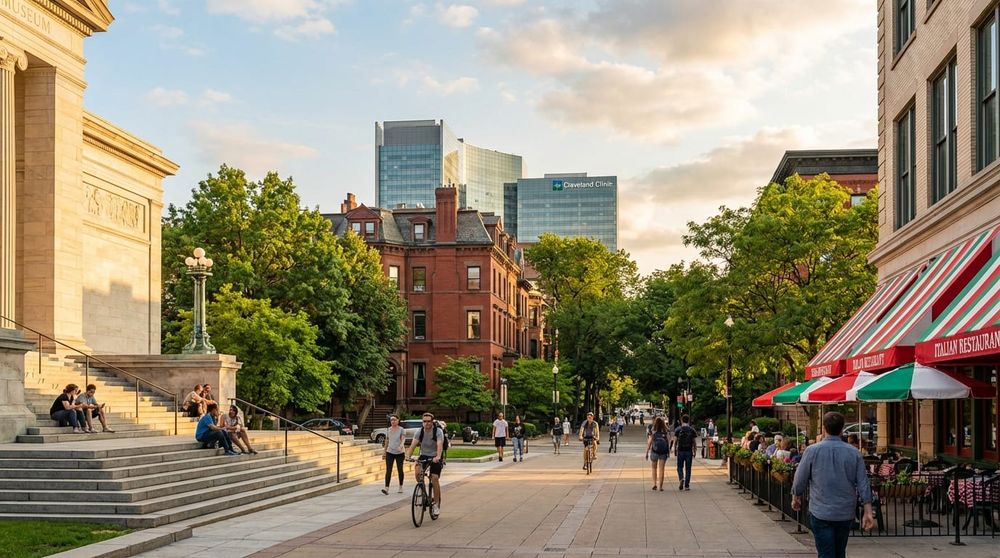
Cleveland's Most Underrated Walkable Neighborhood: University Circle and Little Italy for Buyers Near Cleveland Clinic and University Hospitals in 2026
This guide was prepared by a senior real estate editor with over a decade of experience covering the Greater Cleveland housing market, with input from local transaction data and publicly available market reports. It is intended to provide practical, research-backed guidance for buyers evaluating University Circle and Little Italy in 2026.
TL;DR
- University Circle is situated within walking distance of both Cleveland Clinic and University Hospitals, making it one of Northeast Ohio's most strategically located neighborhoods for medical professionals.
- Recent data suggests the neighborhood is experiencing price appreciation, and buyer competition appears relatively mild based on available market conditions.
- Cleveland's broader market shows inventory increases in early 2026, confirming University Circle attracts real buyer demand.
- The adjacent Little Italy district and Uptown corridor deliver dining, arts, and cultural density that few Northeast Ohio neighborhoods can match at any price point.
- Development activity appears to be occurring in the University Circle area, potentially strengthening long-term property value prospects for buyers in Little Italy and surrounding streets.
- Physicians, residents, fellows, and university staff will find this guide covers pricing, lifestyle, and strategy in practical terms.
Introduction
If you work at Cleveland Clinic or University Hospitals and you're weighing where to buy a home in 2026, University Circle deserves a serious look. Before diving in, a brief orientation is useful: University Circle is the institutional core, home to the hospital campuses, Case Western Reserve University, the Cleveland Museum of Art, and Severance Music Center. Little Italy, anchored by Murray Hill Street to the southeast, is a distinct residential and commercial neighborhood with a walkable retail strip and traditional urban housing stock. The two neighborhoods are adjacent and complementary, separated by a short walk, and this guide addresses both while being specific about where recommendations differ.
It's one of the few areas in Northeast Ohio where you can walk to work, walk to a neighborhood restaurant, and walk to one of the region's notable art museums. The neighborhood doesn't always get top billing in national "best places to live" lists, which is honestly part of its appeal for buyers. Prices have climbed in recent periods but appear to reflect neighborhood fundamentals rather than speculative activity. The cultural infrastructure is dense. And the employment anchor provided by the medical corridor creates a stability that purely residential neighborhoods rarely enjoy.
This guide is written for medical professionals, residents, fellows, and university staff evaluating whether to buy in University Circle or Little Italy. We'll cover current pricing data, what the broader Cleveland market is doing, what nearby development may mean for your long-term investment, and how to approach the buying process strategically in 2026.
University Circle by the Numbers: What the 2026 Market Actually Shows
Median Price and Year-Over-Year Growth
University Circle appears to be posting price appreciation based on available market indicators. For specific median sale prices, current market listing sites and local agents are the most reliable sources, as figures shift month to month. Based on available data: entry-level properties in this area may range considerably, renovated rowhouses in Little Italy's Murray Hill corridor appear to command meaningful prices, and larger renovated homes represent a distinct price tier. These ranges shift with inventory and should be verified with a local agent before you budget.
University Circle's price dynamics aren't happening in isolation. The neighborhood is home to anchor institutions including Cleveland Clinic, University Hospitals, Case Western Reserve University, the Cleveland Museum of Art, and the Cleveland Orchestra. These employers collectively represent tens of thousands of jobs and attract a consistent pipeline of high-income, highly educated buyers and renters. When demand is this structural, price growth tends to be durable.
Market Conditions for Buyers
What makes 2026 a potentially interesting entry point is that individual homes in this area may not attract multiple competing offers. For a physician relocating from a high-pressure coastal market, or a fellow completing training who's ready to stop renting, that's a meaningful advantage. You have the opportunity to negotiate, inspect carefully, and take a measured approach.
Market conditions reflect current inventory and demand dynamics, and those conditions can shift as more buyers discover the corridor's fundamentals. The pricing trends visible in recent data suggest the window may be narrowing. Buyers who have financing in order and a clear sense of their priorities are better positioned than those waiting for perfect conditions that may not materialize.
How University Circle Fits the Broader Cleveland Story
Cleveland's citywide market in March 2026 shows inventory increases that benefit purchasers across the metro. University Circle's position within this market reinforces that buyers are specifically choosing this area for its walkability, employer proximity, and lifestyle density. This reflects genuine neighborhood fundamentals rather than speculative activity.
Little Italy and Uptown: The Lifestyle Layer That Changes the Calculus
What Little Italy Adds to the Value Proposition
Murray Hill, the street that anchors Little Italy, is one of Cleveland's most distinctive commercial corridors. You'll find authentic Italian restaurants, independent galleries, wine bars, and neighborhood events that draw from across the city. For a buyer who's spent years living near a major academic medical center in Boston, Chicago, or New York, Little Italy will feel familiar in the best way. It has the texture of a real neighborhood, not a manufactured mixed-use development.
Residentially, Little Italy offers primarily older housing stock, including brick rowhouses, two-family homes, and renovated single-family properties. The neighborhood skews more intimate in scale compared to University Circle proper, which has a more institutional feel given the density of hospital and university facilities. Buyers who prioritize neighborhood warmth and walkable retail within steps of their front door often find Little Italy the better fit, even though it's a short walk from the hospital campuses.
When your schedule runs long and you're walking home at 9 p.m., having dinner options at street level matters more than it does in the abstract. That's a practical benefit, not just a lifestyle perk.
The Uptown Corridor and Cultural Infrastructure
The Uptown development between University Circle and Little Italy has filled in substantially over the past several years. The Cleveland Museum of Art, which offers free general admission, sits at the center of this corridor. The Cleveland Botanical Garden is steps away. Severance Music Center, home to the Cleveland Orchestra, is within easy walking distance. For buyers with families, this combination of cultural institutions, walkability, and proximity to CWRU's campus creates a live-work-play environment that most Cleveland suburbs cannot replicate.
Schools: What Families Should Know
Families evaluating University Circle and Little Italy should understand the school landscape clearly before committing to a specific block.
The neighborhood falls within the Cleveland Metropolitan School District (CMSD). CMSD has undergone substantial reform efforts over the past decade, and performance varies significantly by individual school. Families should review CMSD's current school assignment maps for the University Circle and Little Italy attendance zones, and cross-reference individual school report cards available through the Ohio Department of Education's website. Relying on district-level averages alone is not sufficient for this evaluation.
The area's strongest option for many families is the concentration of private and parochial schools accessible within a short commute. Several well-regarded independent schools, including those affiliated with CWRU's network and several Catholic schools, serve families in this corridor. Given the concentration of physicians and university faculty in the area, private school enrollment rates tend to be high, and many residents budget for tuition as part of their total housing cost calculation.
Charter and magnet school options within CMSD are also worth researching. Some of Cleveland's higher-performing charter schools draw from across the city and have wait lists. Factoring school placement timelines into your home purchase timeline is a practical step that many relocating families overlook.
Neighborhood Safety and What Relocated Buyers Should Understand
Buyers relocating from out of state often ask about safety in University Circle and Little Italy, and it's a question worth answering directly rather than avoiding.
University Circle benefits from a significant institutional presence. Cleveland Clinic and University Hospitals both maintain private security operations and work closely with Cleveland Police District 2, which covers this area. The concentration of foot traffic from students, hospital staff, and museum visitors during daytime and evening hours creates a more active street environment than many Cleveland neighborhoods.
Little Italy's Murray Hill corridor has historically been one of Cleveland's more stable residential areas, with an engaged community association and lower vacancy rates than many surrounding neighborhoods. The Little Italy Redevelopment Corporation actively coordinates with city services and has maintained consistent investment in the physical corridor.
That said, University Circle and Little Italy exist within Cleveland, and Cleveland's overall crime metrics are higher than national averages in certain categories. The most useful approach for buyers is to review the Cleveland Division of Police's crime mapping tool (clevelandpolice.com) and filter specifically by address or block, rather than relying on city-wide or neighborhood-wide averages that can obscure meaningful block-by-block variation. Drive and walk the specific streets where you're considering buying, at different times of day, before making an offer.
Walkability, Development Momentum, and What They Mean for Your Investment
Why Development Activity Matters for Buyers
One of the most telling indicators of a neighborhood's long-term trajectory is whether institutional capital is betting on it. Development activity in and near the University Circle area may suggest ongoing investment in the corridor. For a buyer in Little Italy or on the edges of University Circle, your property's value doesn't exist in a vacuum. It appreciates based on what's happening on the surrounding blocks. When anchor institutions and private developers are committing to an area, it can create a rising-tide environment for residential buyers who enter the market.
Walkability in Context
University Circle is recognized as a walkable neighborhood, placing it in a small category of Cleveland areas where daily commutes are feasible without a car. For medical professionals whose schedules are unpredictable, a short walk to work eliminates parking costs, reduces commute stress, and improves quality of life in ways that don't show up in any spreadsheet but matter enormously day to day.
Little Italy's walkability is strong for the specific use case of someone working within a half-mile radius of the medical corridor. Murray Hill's restaurants, cafes, and small grocers handle most daily needs. For larger grocery runs or access to other parts of Cleveland, a car or rideshare is practical. Families evaluating the area should also note that the GCRTA Red Line has a University Circle station, providing a public transit option connecting the neighborhood to downtown Cleveland and points east.
Buyer Opportunity: Negotiation Context for 2026
For buyers entering this market in 2026, current market conditions may create opportunities for negotiation on individual properties. Properties that have been on the market for extended periods may attract seller flexibility on price, closing costs, or inspection items. Working with an experienced local agent who understands how to read this dynamic is advantageous.
Buyers should also be aware that in any urban corridor with older housing stock, the distinction between a well-maintained property and one with deferred maintenance can be significant. Budget for a thorough inspection, and prioritize properties where the seller's disclosure and inspection report are consistent. Little Italy's brick rowhouses and Victorian-era homes are often beautiful but may carry costs related to roof age, plumbing updates, or basement waterproofing that factor into total ownership cost.
Investment Timeline: Short-Term Hold vs. Long-Term Ownership
For residents and fellows who may only be in Cleveland for two or three years, the buy-versus-rent question deserves a direct analysis rather than a generic answer.
A short-term hold of two to three years in University Circle carries real transaction costs: buyer-side closing costs typically run 2 to 4 percent of purchase price, and seller-side commissions and fees add another 5 to 6 percent when you exit. In a flat market, that math rarely favors buying. Recent appreciation trends may change the calculation somewhat, but buyers on short timelines should be conservative in their assumptions rather than projecting appreciation forward.
The more compelling case for short-term buyers is rental conversion. The employment anchors at Cleveland Clinic, University Hospitals, and CWRU create reliable tenant demand year-round, particularly from incoming residents, fellows, and graduate students who prefer to rent near campus. A well-located property in Little Italy or adjacent to the CWRU campus has genuine rental market depth. Buyers who enter the market with a clear exit strategy that includes rental conversion are more insulated from the risk of having to sell at an inconvenient time.
For long-term buyers (five years or more), the fundamentals are more straightforwardly favorable. Proximity to major medical and academic employers, ongoing development investment, and Cleveland's cost-of-living advantage relative to coastal markets all point in the same direction. A physician purchasing near the beginning of a long institutional career in Cleveland is buying into a neighborhood with structural demand supports that are unlikely to erode.
The clearest risk factor for any hold period is property-specific condition. In a corridor with older housing stock, an unexpected capital expense (a failed roof, a failing foundation, outdated electrical) can compress or eliminate appreciation gains on a short timeline. Thorough inspection and conservative maintenance budgeting are more important here than in newer-construction markets.
Local Market Insights: What Ohio Buyers Need to Know in 2026
The Ohio housing market in 2026 is performing with notable resilience. Cleveland in particular has benefited from population stabilization, continued healthcare sector growth, and an affordability advantage relative to coastal metros that continues to attract relocating professionals. University Circle sits at the intersection of all these tailwinds.
For buyers relocating from out of state, Cleveland's property tax rates, combined with Ohio's absence of a statewide estate tax, represent meaningful long-term financial advantages. The cost-of-living differential versus similar neighborhoods in Boston or Chicago is substantial, even at higher entry points in the University Circle area.
If you're a resident or fellow evaluating whether to buy now or continue renting, recent market trends suggest that waiting may have had a real cost. Current market conditions offer some negotiating room, but market dynamics may be shifting.
On process: Ohio uses attorneys for title work rather than escrow companies, which is a process difference from some states. Cuyahoga County property taxes are assessed and paid in arrears, so buyers typically receive a credit at closing. Transfer tax rates and deed recording fees are worth reviewing with your agent and attorney before you finalize your budget.
Finding the Right Local Agent
University Circle and Little Italy present nuances that reward buyers who work with agents who know the corridor specifically. Block-by-block conditions vary, development pipelines affect some streets more than others, and the distinction between a property positioned well for long-term appreciation and one that looks similar on paper but carries hidden costs is often only visible to someone with local transaction history in this area.
The Young Team (theyoungteam.com, 216-402-4774, 34105 Chagrin Blvd) is one option serving buyers and sellers across Greater Cleveland, including the University Circle, Little Italy, and Uptown corridors. Their programs include a Worry-Free Listing option for sellers and a Guaranteed Cash Offer program that removes contingency risk in competitive situations. Their Forever Client Care commitment means the relationship continues after closing, which can be a practical advantage for medical professionals who are new to Cleveland and may need ongoing contractor referrals or neighborhood guidance. For current production data and rankings, visit theyoungteam.com directly.
Regardless of which agent you choose, prioritize someone who can provide recent comparable sales specifically within University Circle and Little Italy, rather than broader Cleveland or East Side averages.
Frequently Asked Questions
Is University Circle a good investment for a physician relocating to Cleveland in 2026?
The combination of proximity to Cleveland Clinic and University Hospitals, nearby development potential, and demonstrated price dynamics makes a reasonable case for University Circle as a long-term investment. Current market conditions suggest you can still enter with room for negotiation, which is a favorable combination of fundamentals and buyer-friendly dynamics.
How does Little Italy compare to living in University Circle proper?
Little Italy and University Circle are closely adjacent, with Murray Hill roughly marking the boundary. Little Italy offers more traditional urban residential character, including older housing stock with strong curb appeal and a walkable retail street. University Circle proper skews more institutional in feel given the concentration of hospital and university facilities. Many buyers prioritize Little Italy for its neighborhood warmth while still being a short walk from their employer.
What does recent price growth mean for buyers who want to negotiate?
Don't assume the market is soft, but don't skip negotiations either. Individual properties may not attract multiple offers, which gives buyers room to negotiate on price, terms, and concessions. Working with an agent who knows the specific streets and building histories in this corridor is important.
Are there good options for residents and fellows who may only be in Cleveland for two to three years?
Yes, but the calculus is different. Transaction costs on both ends of a short hold can offset appreciation gains if the market softens. The stronger case for shorter-term buyers is to evaluate rental potential carefully, since the employment anchors in University Circle create reliable tenant demand if you decide to convert your home to a rental after you leave. See the Investment Timeline section above for a fuller breakdown.
What should out-of-state buyers know about the process in Cuyahoga County?
Ohio uses attorneys for title work rather than escrow companies. Cuyahoga County property taxes are assessed and paid in arrears, so buyers typically receive a credit at closing. Review transfer tax rates and deed recording fees with your agent and attorney before finalizing your budget.
Is Little Italy walkable enough for someone without a car?
For daily work commutes to the medical corridor, yes. Murray Hill's restaurants, cafes, and small grocers handle most daily needs. For larger grocery runs or access to other parts of Cleveland, a car or rideshare is practical. The GCRTA Red Line's University Circle station provides an additional public transit option.
Next Steps: Resources and How to Get Started
If you're evaluating University Circle or Little Italy for a home purchase in 2026, here are practical resources to complement your agent conversations:
Neighborhood and Walkability Context: Walk Score's profile for University Circle provides a baseline walkability rating. The University Circle Inc. organization (universitycircle.org) maintains neighborhood development updates and community event information that offer a ground-level view of what's happening in the corridor.
Schools: Review CMSD's current school assignment maps for this area, as well as individual school report cards on the Ohio Department of Education's website. Several private and parochial schools serve this corridor and are worth researching in parallel.
Safety: The Cleveland Division of Police crime mapping tool (clevelandpolice.com) lets you filter by address or block for the most relevant picture of your specific target streets.
Transit: The GCRTA Red Line connects University Circle to downtown Cleveland. The Greater Cleveland RTA trip planner (riderta.com) provides current route and schedule information for buyers who plan to use public transit regularly.
Neighborhood Organizations: The Little Italy Redevelopment Corporation is an active community development organization that provides context on ongoing neighborhood investment and local business activity.
Agent Consultation: The Young Team (theyoungteam.com, 216-402-4774, 34105 Chagrin Blvd) serves buyers across Greater Cleveland including this corridor. Contact them to discuss your timeline, budget, and priorities.
Conclusion
University Circle and Little Italy represent something genuinely rare in the 2026 Cleveland market: a walkable, culturally rich, employer-proximate area where thoughtful buyers can find reasonable entry conditions. Recent market activity tells you other buyers have figured this out. Current market dynamics tell you there is still room for negotiation, though conditions may be evolving.
For physicians, residents, fellows, and university staff evaluating where to plant roots in Northeast Ohio, this corridor combines the practical advantages of a short commute with the long-term financial stability that comes from buying near institutional anchors with deep community investment. Cleveland has always been an underrated city. University Circle and Little Italy may be its most underrated neighborhoods. The market fundamentals in 2026 suggest that's starting to change.