
Radon Testing in Northeast Ohio: Why Cuyahoga County Buyers Should Never Skip This Step
TL;DR
- Northeast Ohio sits in EPA Zone 1, the highest radon risk category in the country.
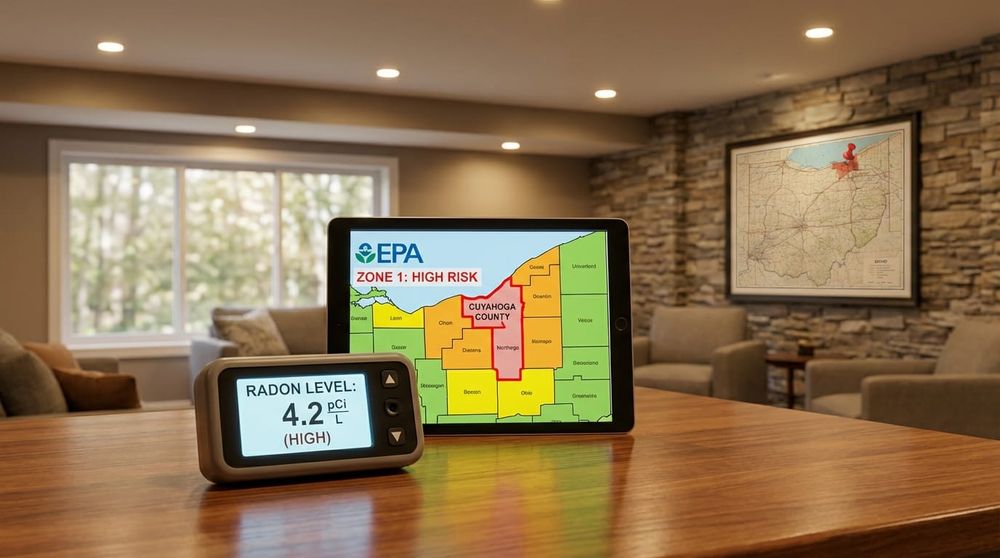
- Cuyahoga County homes frequently test at moderate to high radon levels according to state and county data.
- The EPA action level is 4 pCi/L. Anything at or above that level calls for mitigation.
- Radon is odorless, invisible, and linked to lung cancer. Testing is the only way to detect it.
- In the Cleveland market, radon mitigation systems are common and typically cost far less than most major repairs.
- Buyers in 2026 are increasingly negotiating radon contingencies into purchase contracts.
- Skipping a radon test can impact your health, your resale value, and your negotiating leverage.
Introduction: Why Radon Testing Matters in Northeast Ohio in 2026
If you’re buying a home in Cleveland, Lakewood, Shaker Heights, Pepper Pike, or anywhere in Cuyahoga County, radon testing should never be treated as optional.
Northeast Ohio sits within EPA Zone 1, the highest radon potential classification in the United States. According to the EPA’s Home Buyer’s and Seller’s Guide to Radon, all homes should be tested, and buyers should include radon testing as a standard part of the home inspection process, especially in high-risk areas like ours. Source: https://www.epa.gov/radon/radon-buyers-and-sellers-guide
The Ohio Department of Health identifies Cuyahoga County as having moderate to high radon levels across many communities. Source: https://odh.ohio.gov/know-our-programs/radon-program/radon-program-home
Local reporting continues to highlight how prevalent radon is throughout Northeast Ohio. Cleveland.com recently emphasized that radon is common across the region and often goes undetected without testing. Source: https://www.cleveland.com/news/2024/02/radon-a-silent-killer-is-prevalent-in-northeast-ohio-heres-what-homeowners-need-to-know.html
In today’s 2026 market, where competition remains strong in many Greater Cleveland suburbs, buyers sometimes feel pressure to waive contingencies. But radon testing is one contingency we strongly advise clients to keep.
Let’s break down why.
What Is Radon and Why Is It a Risk in Cuyahoga County?
What Is Radon?
Radon is a naturally occurring radioactive gas that forms from the breakdown of uranium in soil and rock. It rises from the ground and can seep into homes through:
- Foundation cracks
- Sump pits
- Drain tiles
- Crawl spaces
- Gaps around utility penetrations
You cannot see it. You cannot smell it. You cannot taste it.
Testing is the only way to know if a home has elevated levels.
According to the EPA, radon exposure is a leading cause of lung cancer among non-smokers. Source: https://www.epa.gov/radon/radon-buyers-and-sellers-guide
Why Is Northeast Ohio High Risk?
The geology of Northeast Ohio contributes to elevated radon levels. The EPA classifies the region as Zone 1, meaning predicted average indoor radon levels exceed 4 pCi/L, which is the EPA’s action threshold.
The Ohio Department of Health’s Radon Program confirms that many homes across Cuyahoga County test in moderate to high ranges. Source: https://odh.ohio.gov/know-our-programs/radon-program/radon-program-home
The Cuyahoga County Board of Health also publishes local radon information and offers access to free test kits for residents. Source: https://cuydhd.org/environmental-health/radon/
In short, this is not a rare issue in our area. It is common.
What Does 4 pCi/L Mean for Buyers?
The EPA recommends taking action if radon levels are 4 picocuries per liter (pCi/L) or higher.
Here’s how buyers should interpret that number:
- Below 2 pCi/L: Low risk, generally considered acceptable
- 2 to 3.9 pCi/L: Consider mitigation
- 4 pCi/L or higher: Mitigation recommended
Source: https://www.epa.gov/radon/radon-buyers-and-sellers-guide
If a home in Rocky River tests at 5.2 pCi/L, or a property in University Heights tests at 8.0 pCi/L, that does not mean you should walk away. It means you should negotiate.
Radon is one of the most fixable environmental concerns in residential real estate.
How Much Does Radon Mitigation Cost in the Cleveland Market?
In the Greater Cleveland area in 2026, most radon mitigation systems typically range from approximately $1,000 to $1,800, depending on:
- Home size
- Foundation type
- Slab versus basement construction
- Accessibility
These systems usually involve installing a vent pipe and fan system that pulls radon gas from beneath the home and vents it safely above the roofline.
Compared to roof replacements or foundation repairs, radon mitigation is relatively straightforward and common in Cuyahoga County.
In fact, many homes in Lakewood, Parma, Solon, and Strongsville already have mitigation systems installed before hitting the market.
How to Negotiate a Radon Contingency in 2026
Step 1: Include It in Your Inspection Contingency
When you submit an offer, your agent can include a radon testing clause within the home inspection contingency. This allows:
- Professional testing during the inspection period
- Renegotiation if levels exceed 4 pCi/L
The EPA encourages buyers to test before closing and resolve elevated levels prior to completing the purchase. Source: https://www.epa.gov/radon/radon-buyers-and-sellers-guide
Step 2: Use the Results Strategically
If levels test above 4 pCi/L, you typically have options:
- Request the seller install a mitigation system before closing
- Request a credit at closing
- Negotiate a price reduction
In today’s competitive 2026 Northeast Ohio market, where inventory remains tight in many Cleveland suburbs, structure matters. You can still stay competitive while protecting yourself.
According to Ohio Realtors market statistics, inspection-related negotiations, including environmental concerns like radon, have become more common as buyers prioritize long-term safety and value. Source: https://www.ohiorealtors.org/market-statistics/
Step 3: Confirm Post-Mitigation Testing
After installation, a follow-up test confirms that levels have dropped below the action threshold.
If you are relocating to Cleveland from a state with lower radon prevalence, this extra step provides peace of mind.
What Happens If You Discover High Radon After Closing?
If you skipped testing and discover elevated levels after closing, you can still install a mitigation system. The process is similar.
However:
- You lose negotiation leverage
- You bear the full cost
- You may face resale disclosure questions later
In 2026, buyers in Cuyahoga County are more aware of radon than ever. A home without testing history or mitigation documentation may raise questions when you sell.
Testing protects not only your health but your future equity.
Local Market Insights: Radon and the 2026 Northeast Ohio Buyer
In our experience serving over 500 families annually across Greater Cleveland, Akron, and Canton, radon testing has shifted from “optional add-on” to “standard expectation.”
Here’s what we’re seeing in 2026:
- Most professional home inspections in Cuyahoga County include radon testing
- Sellers increasingly pre-test and install mitigation systems before listing
- Relocating professionals ask about radon early in the process
- Homes with mitigation systems do not experience value penalties
In competitive micro-markets like Rocky River, Beachwood, and Hudson, buyers still win homes while maintaining smart inspection protections. The key is strategy.
For a broader look at 2026 housing dynamics, including inventory and competition levels, you can review our market insights here: https://www.ohiorealestatesource.com/blog/northeast-ohio-market-2024
Even in a strong seller-leaning environment, you do not have to sacrifice health-related protections.
Why Choose The Young Team
Since 2003, The Young Team has helped more than 4,000 families buy and sell homes across Northeast Ohio. We are:
- The #1 Real Estate Team in Ohio
- The #15 team in the United States by units sold
- Keller Williams Greater Metropolitan
- 30+ years of combined experience
- $1B+ in total real estate sold
- 1,470+ five-star Google reviews
- 500+ families served annually
Our mission is simple: to revolutionize real estate through exceptional client experiences.
What That Means for Buyers
Client First Approach We structure offers that protect your health, finances, and long-term investment.
Lean on Experience With thousands of transactions across Cuyahoga, Summit, Stark, Medina, Lake, Geauga, Lorain, and Portage Counties, we know how to navigate inspection negotiations smoothly.
Embrace Innovation We stay ahead of environmental trends, inspection standards, and market data so you are never caught off guard.
Programs That Protect You
- First-Time Home Buyer Guidance
- Relocation Assistance
- Buyer Representation with strategic offer planning
- Access to trusted local radon mitigation professionals
- Forever Client Care with vetted vendor referrals
When you work with our team, you are not just buying a house. You are building a long-term plan.
Frequently Asked Questions About Radon in Cuyahoga County
Is radon common in Cleveland and Cuyahoga County?
Yes. Northeast Ohio is classified as EPA Zone 1, the highest radon risk category. State and county health departments confirm moderate to high levels throughout the region.
Sources: https://odh.ohio.gov/know-our-programs/radon-program/radon-program-home https://cuydhd.org/environmental-health/radon/
Should I waive radon testing in a competitive market?
In Cuyahoga County, we strongly advise against waiving radon testing. It is a manageable issue, and testing provides leverage and peace of mind.
Does a radon mitigation system hurt resale value?
No. In many Northeast Ohio communities, mitigation systems are common and expected. Proper documentation can actually make resale smoother.
Can I test a home myself?
Yes. The Cuyahoga County Board of Health offers access to free test kits. However, during a real estate transaction, professional testing during the inspection period is recommended.
Source: https://cuydhd.org/environmental-health/radon/
Next Steps
If you are buying a home in Cleveland, Akron, Canton, or anywhere in Cuyahoga County, let’s make sure your inspection strategy protects you.
Call The Young Team at 216-402-4774 Visit us at theyoungteam.com Stop by our office at 34105 Chagrin Blvd, Moreland Hills, OH 44022
Whether you are a first-time buyer in Lakewood, relocating to Pepper Pike, or investing in Tremont, we will guide you step by step.
Conclusion: Protect Your Health, Protect Your Investment
Radon testing in Northeast Ohio is not a scare tactic. It is a smart, routine part of buying a home in a high-risk region.
Cuyahoga County buyers in 2026 are more informed than ever. They understand that testing is simple, mitigation is manageable, and prevention is powerful.
When you combine smart inspection strategy with experienced local guidance, you buy with confidence.
At The Young Team, we are proud to serve the communities we call home and to help you make decisions that protect your family today and your investment tomorrow.