
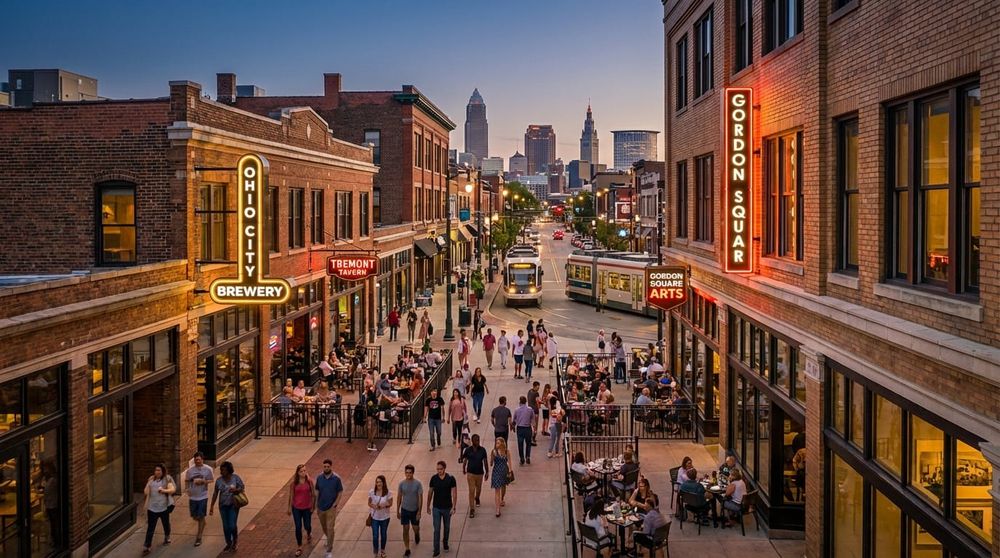
Best Cleveland Neighborhoods for Nightlife and Walkability Ranked: Ohio City, Tremont, Downtown, and Gordon Square Compared for 2026 Buyers
Researched and written by The Young Team, a top-ranked Keller Williams real estate team, with extensive transaction experience across Cleveland's urban neighborhoods.
TL;DR
- Downtown Cleveland leads walkability, anchored by the Warehouse District's dense bar and restaurant scene
- Ohio City ranks as Cleveland's premier craft beer and artisan neighborhood, with galleries and breweries concentrated along West 25th Street
- Tremont offers strong walkability, backed by a thriving restaurant row and arts gallery scene
- Gordon Square anchors Cleveland's arts district on Detroit Avenue, offering an emerging nightlife corridor with lower entry prices than Ohio City
- Urban neighborhoods in Cleveland remain competitively priced for urban living compared to peer Midwest cities
- Tremont offers compelling affordability for first-time buyers seeking walkable urban living
- 2026 represents a compelling entry window for urban lifestyle buyers, short-term rental investors, and remote workers prioritizing amenities over commute proximity
Introduction
Cleveland's urban neighborhoods have quietly become some of the most compelling walkable communities in the Midwest. While coastal cities price out buyers seeking the live-work-play lifestyle, Cleveland's west side corridor and downtown core offer genuine urban energy at a fraction of comparable markets. If you've been watching Ohio City fill up with craft breweries, or noticed Tremont's restaurant scene expanding block by block, you're picking up on something real.
For 2026 buyers, the decision isn't just "do I want to live in Cleveland?" It's "which Cleveland neighborhood actually fits how I live?" That's a different and more interesting question. Do you want to walk to a cocktail bar on a Tuesday? Bike to a gallery opening on a Saturday? Work remotely from a coffee shop you can reach without a car? Each of these four neighborhoods delivers a distinct version of urban lifestyle, with its own tradeoffs on price, density, transit access, and nightlife character.
This ranked breakdown gives you concrete scoring across the metrics that matter most for lifestyle-focused buyers: walkability, bar and restaurant density, transit access, property availability, and price-per-square-foot context. Use it to match your lifestyle to the right market before you start touring homes.
How We Ranked These Neighborhoods
Each neighborhood was evaluated across five dimensions: Walk Score, nightlife and dining density, transit access, current property availability, and relative affordability for 2026 buyers. Walk Score figures referenced throughout this article reflect publicly available data from WalkScore.com and are used as directional benchmarks rather than precise real-time measurements, since individual addresses within each neighborhood will vary. No single metric determines the ranking. The goal is a complete picture for buyers whose daily quality of life depends on what's accessible without a car.
Neighborhood Snapshot: Price and Walkability at a Glance
The table below summarizes the four neighborhoods across the key metrics covered in this article. Use it as a quick reference before diving into the full profiles.
| Neighborhood | Walkability | Typical 2BR Price Range | Nightlife Character | Transit Access |
|---|---|---|---|---|
| Downtown Cleveland | High walkability; densely walkable neighborhoods | $250,000–$400,000* | Highest density; Warehouse District and East 4th | Strongest (HealthLine + RTA buses) |
| Ohio City | High walkability | Mid-$200,000s–Low $300,000s* | Craft breweries; West 25th corridor | Strong (Rapid Station) |
| Tremont | Walkable | $175,000–$240,000* | Restaurant row; arts galleries | Moderate (bus; limited weekends) |
| Gordon Square | Walkable | $130,000–$200,000* | Arts district; indie venues | Serviceable (bus; limited weekends) |
*Pricing ranges reflect general listing activity as of early 2025 and are provided for reference only. For current MLS data and active inventory, contact The Young Team or consult the Northeast Ohio Regional MLS (NORMLS) directly.
1. Downtown Cleveland
Nightlife and Walkability Profile
Downtown Cleveland earns a top walkability ranking in this comparison, and the Warehouse District is the engine behind that ranking. Residents describe being able to reach restaurants, bars, grocery options, and entertainment venues entirely on foot, a daily reality that most suburban buyers underestimate until they experience it firsthand. The neighborhood's compact street grid, combined with the density of venues on West 6th Street and East 4th Street, creates the kind of walkable nightlife corridor that typically commands much higher price premiums in peer cities.
Specific venues define the experience here. On West 6th, spots like Punch Bowl Social and Bar Louie anchor a stretch walkable within roughly two to three blocks of most downtown residential buildings. East 4th Street, lined with chef-driven restaurants including Lola Bistro and Greenhouse Tavern, adds a more upscale dining character. The average walk from a centrally located downtown condo to the nearest bar or restaurant runs well under a quarter mile, a walkability advantage that is difficult to replicate in any other neighborhood on this list.
Transit access here is strong, with RTA bus lines and the HealthLine serving Downtown residents with regular service, providing genuine car-optional flexibility on both weekdays and weekends. For remote workers who occasionally need to travel, proximity to Cleveland Hopkins via freeway access adds practical value.
Safety Context
As with any urban core, crime rates in Downtown Cleveland vary by block and by time of day. The Cleveland Division of Police publishes crime data by district at police.city.cleveland.oh.us, which buyers can use to examine specific blocks within the Warehouse District or Gateway area. Generally, the Warehouse District and East 4th corridor are considered among the more active and, consequently, more visible and patrolled areas of downtown. Buyers focused on nightlife walkability should review block-level data for the specific buildings they are considering.
Property and Pricing Context
Downtown Cleveland's condo inventory skews toward converted loft spaces, high-rise units, and newer mixed-use developments. Pricing varies based on building vintage, floor level, and included amenities. HOA fees on many condo buildings can meaningfully affect total monthly costs and buyers should factor those carrying costs into affordability calculations. That said, Downtown remains attainable compared to comparable walkable neighborhoods in Chicago, Minneapolis, or Columbus.
Regarding short-term rentals: Cleveland's downtown core falls under the city's short-term rental registration ordinance, which requires property owners to obtain a permit and comply with occupancy and safety standards. Individual condo buildings may impose their own additional restrictions, so buyers pursuing this strategy should review HOA rules carefully before purchasing.
Best Fit For
Urban buyers who want maximum walkability, nightlife density, and transit access, and who are comfortable with condo ownership in a vertical living environment.
2. Ohio City (High Walkability)
Nightlife and Walkability Profile
Ohio City is Cleveland's most culturally distinct neighborhood for buyers who prioritize craft food and beverage culture alongside genuine community character. Cleveland Scene consistently recognizes Ohio City as one of the city's most walkable and culturally active neighborhoods, with craft breweries, independent galleries, and chef-driven restaurants concentrated along West 25th Street between the West Side Market and Clark Avenue. The West Side Market itself, open since 1912, functions as both a practical amenity and a social anchor that distinguishes Ohio City from any other neighborhood in this comparison.
On the nightlife side, the roster here is specific and well-established. Market Garden Brewery and Nano Brew Cleveland anchor the craft beer corridor on West 25th. Platform Beer Co. draws visitors from across the region. For dining, Larder Delicatessen and Bakery and The Black Pig represent the chef-driven independent restaurant scene that has made Ohio City a regional food destination. The average walk from West 25th-area homes to the nearest brewery or bar runs approximately 0.2 to 0.4 miles, a compact range that supports genuine on-foot nightlife use.
Ohio City reflects genuine walkability. The core around the Market and West 25th is legitimately walkable for daily errands, dining, and nightlife. RTA's West 25th rapid station provides direct downtown access. That transit asset is meaningful for buyers who want to skip the car on game nights or evenings out.
Safety Context
Ohio City's West 25th corridor and the blocks immediately surrounding the West Side Market are among the most foot-trafficked stretches on Cleveland's west side, which generally correlates with higher visibility and lower street-level crime risk in the immediate nightlife zone. As in any urban neighborhood, conditions vary by block. The Cleveland Division of Police crime map (police.city.cleveland.oh.us) allows buyers to review incident data for specific streets before purchasing.
Property and Pricing Context
Ohio City draws buyers seeking single-family homes and two-family investment properties alongside a growing condo market. The neighborhood's relative scarcity of newer construction means buyers often compete for well-maintained Victorian-era homes and converted flats. Pricing varies with updated homes near the Market commanding premiums. Ohio City has posted consistent year-over-year appreciation, reflecting sustained demand from young professionals and investors.
For short-term rental investors, Ohio City's walkability, proximity to downtown event venues, and strong name recognition support consistent platform demand. Buyers pursuing this strategy should verify current permit requirements under Cleveland's short-term rental registration ordinance and confirm that the specific building or structure they are purchasing does not carry HOA or deed restrictions that limit rental activity. For current rental rate benchmarks, consult AirDNA or similar short-term rental analytics platforms, which track average nightly rates and occupancy by neighborhood.
Best Fit For
Buyers who want walkable nightlife with neighborhood character, craft culture, and the option to build equity in a property with investment potential.
3. Tremont (Walkable)
Nightlife and Walkability Profile
Tremont's reputation is built on two things: its restaurant row and its galleries. That community preference aligns with the neighborhood's physical layout: Lincoln Park anchors the core, with bars and restaurants radiating outward along Professor Avenue and West 14th Street.
The venue list here is well-defined. Parallax Restaurant and Treehouse stand as long-established anchors on the dining and bar side. The South Side bar on College Avenue is a neighborhood institution, and Prosperity Social Club on Starkweather Avenue draws a loyal local crowd. The arts side is anchored by 78th Street Studios and a cluster of independent galleries along Professor Avenue. For buyers who want to walk to dinner and a gallery opening on the same evening, this corridor is genuinely well-suited.
The arts and dining concentration in Tremont has deep roots, with galleries and independent restaurants establishing the neighborhood's cultural identity over decades. What's notable in 2026 is how that foundation has supported continued growth without the displacement pressures that have hit comparable neighborhoods in other Midwest cities. Tremont retains a genuine mixed-income, mixed-use character that appeals to buyers who want nightlife access without a purely commercial atmosphere.
Tremont offers solid walkability. Some daily errands may still require a car, and transit options are more limited here. Bus service on West 14th and nearby corridors runs on weekday schedules with reduced weekend frequency, making car-free daily living workable but less seamless than Downtown or Ohio City. For buyers whose primary need is restaurant and nightlife access within walking distance, Tremont delivers well. The average walk from Tremont residential streets to Professor Avenue's restaurant row runs roughly 0.3 to 0.6 miles depending on starting block.
Safety Context
Tremont is generally regarded as one of Cleveland's more stable urban residential neighborhoods, with active community organizations and consistent reinvestment. Buyers can review block-level crime data through the Cleveland Division of Police at police.city.cleveland.oh.us to assess conditions on specific streets they are considering.
Property and Pricing Context
Tremont offers compelling affordability for first-time buyers. Inventory includes a healthy mix of historic single-family homes, converted two-families, and newer infill construction. For the most current data on days-on-market, absorption rates, and price-per-square-foot trends in Tremont, buyers should request a neighborhood market report from the Northeast Ohio Regional MLS (NORMLS) or ask The Young Team for a current comparable analysis. General market observation reflects that well-priced Tremont properties have moved more quickly in recent cycles than they did in 2022 and 2023, a pattern consistent with tighter inventory conditions across Cleveland's urban west side.
On short-term rentals: Tremont properties fall under the same citywide short-term rental registration framework as the rest of Cleveland. Buyers should confirm current permit requirements and review any community-level feedback on enforcement before committing to a rental strategy.
Best Fit For
First-time buyers, value-focused buyers, and remote workers who want a walkable arts-and-dining neighborhood at a price point that leaves room in the budget for everything else.
4. Gordon Square (Walkable)
Nightlife and Walkability Profile
Gordon Square is Cleveland's arts district in the most literal sense: the neighborhood's identity is organized around the Detroit Shoreway Arts District, with the Capitol Theatre, the Near West Theatre, and a concentrated strip of independent bars and restaurants along Detroit Avenue. Where Ohio City skews toward craft brewery culture and high-volume nightlife, Gordon Square's corridor along Detroit Avenue leans toward performance arts, indie music venues, and neighborhood-scale dining, creating a distinctly lower-key but culturally active atmosphere.
The venue roster here reflects that character. Music Box Supper Club is a regional anchor, booking national touring acts in an intimate setting. The Lake Erie Monster taproom and Gypsy Beans coffee anchor the casual side of the strip. For dining, Bar Cento and Banter Beer and Wine round out a walkable stretch along Detroit Avenue that runs approximately 0.4 to 0.7 miles from most Gordon Square residential blocks. The Capitol Theatre hosts film screenings, community events, and live performances within easy walking distance of the neighborhood's residential core.
For buyers who find Ohio City's weekend crowds less appealing but still want genuine walkable nightlife within a culturally active community, Gordon Square offers a quieter but equally interesting alternative. The neighborhood draws a creative professional demographic, and its relative affordability compared to Ohio City has accelerated buyer interest over the past several years.
Transit access is serviceable but more limited. Bus connections to downtown exist along Detroit Avenue, with service running on standard RTA schedules. The car-optional lifestyle is more limited here than in Downtown or Ohio City.
Safety Context
Gordon Square's Detroit Avenue corridor has seen sustained investment from the Detroit Shoreway Community Development Organization, which has contributed to a more stable commercial and residential environment along the main strip. As with other urban neighborhoods, conditions vary away from the main corridor. Buyers should consult the Cleveland Division of Police crime map at police.city.cleveland.oh.us for block-level data on streets they are actively considering.
Property and Pricing Context
Gordon Square consistently offers lower entry prices among the four neighborhoods in this comparison. The mix includes older single-family homes, two-families, and a small but growing condo supply. Gordon Square offers an accessible entry point into a genuinely creative neighborhood.
For short-term rental investors, the neighborhood's arts-district positioning and proximity to Edgewater Park create a distinct appeal for platform guests. For current nightly rate benchmarks and occupancy data by submarket, AirDNA and similar platforms track Gordon Square as part of the broader Cleveland west side market. The Detroit Shoreway community development organization has historically been engaged in shaping neighborhood character, so buyers should monitor any community-level guidance that may affect short-term rental density over time.
Best Fit For
Arts-oriented buyers, investors seeking lower entry points with appreciation upside, and buyers who want walkable cultural amenities with less commercial density than Ohio City or Downtown.
Local Market Insights for 2026 Urban Cleveland Buyers
Cleveland's urban core benefits from a convergence of conditions that makes 2026 a structurally interesting entry point. For verified, current data on absorption rates, days-on-market trends, and price-per-square-foot by neighborhood, buyers should consult NORMLS market reports or request a neighborhood-specific analysis from The Young Team. General market observation across the four neighborhoods in this comparison reflects tighter inventory than was present in 2022 and 2023, particularly in Ohio City and Tremont, where demand from young professionals and investors has absorbed available listings at a faster pace.
The affordability story extends across the corridor: Gordon Square offers accessible entry points, while Ohio City and Downtown command premiums that still compare favorably to peer-city equivalents. For buyers currently renting in any of these four neighborhoods, the purchase-versus-rent calculation increasingly favors homeownership for those who can qualify for financing.
Price-per-square-foot comparisons across the four neighborhoods confirm a general hierarchy: Downtown and Ohio City command higher per-square-foot premiums relative to Tremont and Gordon Square. For buyers optimizing on value-per-walkability-unit, Tremont and Gordon Square represent compelling options. For buyers optimizing on maximum urban amenity access, Downtown offers the strongest walkability and transit infrastructure.
Why Choose The Young Team
The Young Team is a top-ranked Keller Williams real estate team operating in the Greater Cleveland metropolitan area, with a mission to help Ohio buyers and sellers make confident, informed real estate decisions backed by local expertise and genuine client care.
For buyers actively researching Cleveland's urban neighborhoods, working with a team that has direct transaction experience across these four markets matters in ways that are easy to underestimate. Knowing which blocks in Tremont have the best walkability to Professor Avenue's restaurant row, which Ohio City buildings have HOA rules that restrict short-term rentals, or which Gordon Square streets are seeing the most investor activity is the kind of ground-level knowledge that changes the quality of a buying decision. The Young Team brings that familiarity to every client conversation.
Two programs are worth flagging for buyers who are also selling a current property. The Worry-Free Listing program reduces the friction that often prevents move-up buyers from entering the urban market by addressing seller-side timing concerns directly. The Guaranteed Cash Offer program gives buyers who are also selling a competitive positioning tool in tight inventory conditions, a meaningful advantage in neighborhoods like Ohio City and Tremont where well-priced properties move quickly.
To learn more about The Young Team's specific transaction history across Cleveland's urban neighborhoods, client satisfaction ratings, and the agents who specialize in each market, visit theyoungteam.com or call their office directly.
Frequently Asked Questions
Which Cleveland neighborhood has the highest Walk Score in 2026?
Downtown Cleveland leads in walkability, driven by the Warehouse District's concentration of restaurants, bars, and entertainment venues within walking distance of residential buildings. Ohio City and Tremont follow with strong walkability, while Gordon Square also offers solid walkability along the Detroit Avenue corridor.
What are typical home prices in Tremont for 2026 buyers?
Tremont offers compelling affordability for first-time buyers and those seeking walkable urban living, with pricing that makes homeownership accessible compared to comparable walkable neighborhoods elsewhere. See the Local Market Insights section for a full price comparison across all four neighborhoods. For verified current pricing, consult NORMLS data or speak with The Young Team.
Is Ohio City a good neighborhood for short-term rental investors?
Ohio City's walkable amenities, proximity to downtown Cleveland event venues, and strong name recognition make it a consistent performer for short-term rental strategies. Cleveland's citywide short-term rental registration ordinance applies here, and buyers should verify current permit requirements and any building-specific HOA restrictions before purchasing with rental intent. For current nightly rate and occupancy benchmarks, AirDNA tracks the Ohio City submarket.
How does Gordon Square compare to Ohio City for nightlife buyers?
Gordon Square skews toward arts-district nightlife: performance venues like the Capitol Theatre and Music Box Supper Club, indie music, and neighborhood-scale bars and restaurants along Detroit Avenue. Ohio City offers a different nightlife character with more breweries and higher-volume venues, including Market Garden Brewery and Platform Beer Co. The choice depends on whether you prefer a quieter, arts-focused atmosphere or a more energetic craft-focused corridor.
Are Cleveland's urban neighborhoods affordable compared to other Midwest cities?
Yes. Walkable neighborhoods like Tremont and Gordon Square offer compelling entry points that place Cleveland well below comparable urban markets in Columbus, Chicago, and Minneapolis at similar walkability scores. For buyers prioritizing urban lifestyle at a sustainable price point, Cleveland's west side corridor and downtown core offer genuine value in 2026.
What transit options exist for car-free living in these neighborhoods?
Downtown Cleveland offers the strongest transit infrastructure, including multiple RTA bus lines and the HealthLine, which serves Downtown residents regularly, providing genuine car-optional flexibility on both weekdays and weekends. Ohio City is served by the West 25th RTA rapid station. Tremont has bus access on West 14th and nearby routes, with reduced weekend frequency. Gordon Square is served by bus along Detroit Avenue on standard RTA schedules with limited weekend service. Buyers planning a fully car-free lifestyle will find Downtown and Ohio City most practical.
Where can I find crime and safety data for these neighborhoods?
The Cleveland Division of Police publishes block-level crime data at police.city.cleveland.oh.us. Buyers can use this resource to review incident patterns for specific streets within any of the four neighborhoods covered here before making a purchase decision.
Next Steps: Work With a Team That Knows These Neighborhoods
If you're ready to move from ranking neighborhoods on paper to actually touring properties, The Young Team is the right starting point. They've worked across all four of these markets and can give you a realistic picture of current inventory, realistic price expectations, and the specific tradeoffs you'll encounter in each neighborhood's 2026 market.
Reach out directly to The Young Team through their website at theyoungteam.com or call their office to speak with an agent familiar with Cleveland's urban neighborhoods. The team is based in the Greater Cleveland area and available to walk you through the Worry-Free Listing and Guaranteed Cash Offer programs if you're also selling a current property.
Conclusion
Cleveland's four leading walkable neighborhoods each deliver a distinct version of urban lifestyle, and the right choice depends more on how you actually live than on any single ranking metric. Downtown wins on walkability and nightlife density. Ohio City delivers craft culture and community character. Tremont offers compelling value in the comparison. Gordon Square gives arts-oriented buyers an accessible entry point into a genuinely creative neighborhood.
What connects all four is a broader reality: Cleveland's urban core offers a quality of walkable, nightlife-accessible living that most buyers don't fully appreciate until they're in it. In 2026, the price points across these neighborhoods mean that urban lifestyle ownership is still within reach for buyers who are paying attention. The window is real. The question is which neighborhood fits the life you're building.