
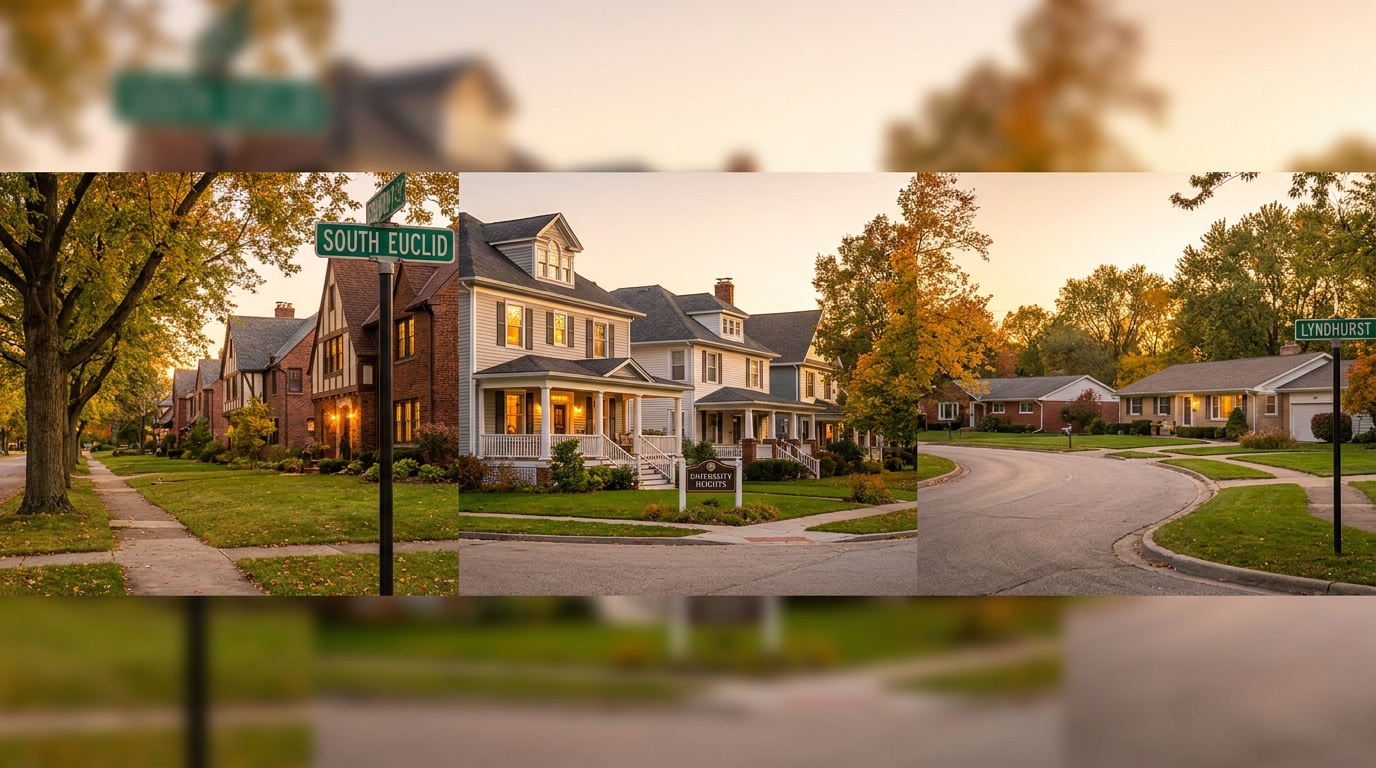
South Euclid, University Heights & Lyndhurst: Key Takeaways
- These three east-side suburbs deliver inner-ring location, established schools, and real housing inventory without the premium pricing of Beachwood or Shaker Heights.
- Median price ranges differ by community: South Euclid and Lyndhurst historically trade in roughly the mid-$200K to mid-$400K band; University Heights trends slightly higher, with values appreciating year-over-year according to Zillow's University Heights home value data.
- Days-to-contract are short. Inner-ring east-side submarkets, including University Heights, remain among the fastest-moving in the Cleveland metro, with competitive offers common on well-conditioned homes.
- South Euclid-Lyndhurst City Schools serves both South Euclid and Lyndhurst; Cleveland Heights-University Heights City Schools serves University Heights.
- Commute times to downtown Cleveland are generally in the range of approximately 20-30 minutes via I-271 or I-480, with strong access to University Circle, Cleveland Clinic, and Case Western Reserve.
- Proximity to Euclid Creek Reservation and the broader Cleveland Metroparks system adds amenity value that many east-side buyers cite as a draw.
- Local expertise matters. Each community has a distinct buyer profile, price trend, and inventory pattern. A generalist defaults to the names everyone knows.
The Inner-Ring Suburbs Everyone Knows, and Three You Should Too
If you've been searching for a home on Cleveland's east side, you've heard the same names repeated. Shaker Heights. Beachwood. Maybe Cleveland Heights. Those are real markets with real merit, and buyers who can compete there often win. But if you walk away without asking what else exists at a lower entry price and comparable fundamentals, you may be leaving value on the table.
South Euclid, University Heights, and Lyndhurst occupy that gap. They share the same general geography, the same access to University Circle employers, the same Metroparks greenways, and in some cases the same school district pipeline as their more-marketed neighbors. Yet they consistently attract less bidding-war pressure and offer more options for buyers widening their search across Northeast Ohio to find more home for their budget.
These three communities are not speculative bets. They're not "up and coming" in the hype sense. They have established neighborhoods, functioning school districts, and documented buyer demand. They're simply less marketed. This article breaks down each one specifically, so you can decide whether any of them fits your timeline, budget, and goals.
All three fall within the Young Team's Cuyahoga County service area.
Inner-Ring Titans vs. The Overlooked Three: Side-by-Side
| Factor | Shaker Heights / Beachwood / Westlake | South Euclid / University Heights / Lyndhurst |
|---|---|---|
| Median Home Price Range | Approximately $350K-$700K+ (Shaker/Beachwood); approximately $350K-$600K (Westlake) | Approximately $220K-$420K (South Euclid/Lyndhurst); approximately $280K-$520K (University Heights) |
| Days to Contract | Historically fast; Shaker and Beachwood regularly move quickly on well-priced listings | Competitive but with more breathing room; signals suggest University Heights mirrors inner-ring pace on updated homes |
| School District Reputation | Shaker Heights City Schools and Beachwood City Schools are among Ohio's most recognized | South Euclid-Lyndhurst City Schools and Cleveland Heights-University Heights City Schools are established, regionally respected districts |
| Commute to Downtown Cleveland | Generally around 20-30 minutes (Shaker/Beachwood); approximately 30-40 minutes (Westlake) | Approximately 20-30 minutes via I-271 or I-480 from all three communities |
| Home Styles | Larger Colonials, Tudors, and mid-century ranches; some new construction in Beachwood | Brick ranches, Cape Cods, Colonials from the 1950s-1970s; tree-lined lots; consistent block character |
| Buyer Profile: Best Fit | Move-up buyers, established professionals, buyers prioritizing name-brand districts | First-time buyers, relocating professionals, move-up families seeking value without sacrificing location |
| Effective Property Tax Rate (est.) | Beachwood: approximately 1.8%-2.2%; Shaker Heights: approximately 2.8%-3.2% of market value | South Euclid: approximately 2.4%-3.0%; Lyndhurst: approximately 2.2%-2.8%; University Heights: approximately 2.6%-3.2% of market value |
Note: Property tax estimates above are directional ranges based on publicly reported Cuyahoga County millage schedules. Actual effective rates vary by assessed value, levy cycles, and exemptions. Consult a licensed CPA or your lender for a total-cost-of-ownership calculation specific to any property you are evaluating.
The price differential is the headline, but it's not the only factor. Homes in the "overlooked three" are generally older stock with established landscaping, walkable block character, and access to the same east-side employment corridor. Inner-ring suburbs are still highly competitive across the Cleveland metro, and that dynamic holds here.
The practical difference: buyers who stretch to Beachwood or Shaker often sacrifice square footage or condition to stay in budget. In South Euclid, Lyndhurst, or University Heights, that same budget historically yields more space and more options. Signals suggest this gap may persist into 2026 as inventory remains tight across inner-ring Cuyahoga County. Spring typically brings higher inventory across all three communities. Buyers who move in late winter, particularly January through early March, often find less competition and more motivated sellers.
South Euclid: Established Schools, Moderate Pricing, Direct Access
South Euclid sits in Cuyahoga County directly east of Cleveland Heights, giving it one of the most convenient positions on the east-side map. Buyers who need quick access to University Circle, Cleveland Clinic, or Case Western Reserve find the drive straightforward, with I-271 and Route 322 both nearby.
The school district, South Euclid-Lyndhurst City Schools, serves both this community and neighboring Lyndhurst. The district has maintained consistent regional standing and draws buyers who want a known public school option without the premium attached to Beachwood or Orange City Schools.
Housing stock leans toward brick ranches, Cape Cods, and two-story Colonials from the 1950s through 1970s. Lots are typically generous by inner-ring standards, with mature trees and defined block character. The Mayfield Road corridor anchors daily conveniences, including grocery, pharmacy, and dining, and the blocks north of Green Road tend to draw buyers looking for quieter residential streets with consistent lot sizes. According to Redfin's South Euclid market data, the market has shown competitive offer activity, near-list-price sales, and sustained buyer demand. The Homes.com South Euclid neighborhood guide describes tree-lined streets, proximity to University Circle institutions, and local shopping corridors along Mayfield Road and Green Road that give the area daily-convenience infrastructure.
For buyers consulting Realtor.com's Cuyahoga County data for South Euclid, the community prices noticeably below broader county benchmarks while maintaining institutional anchors including John Carroll University, which sits on the South Euclid-University Heights border, and access to Cleveland Clinic facilities. That combination of anchor proximity and accessible pricing explains sustained buyer and investor interest.
The Young Team's transaction data in South Euclid shows that blocks north of Green Road consistently move faster than those closer to Mayfield Road, with days-to-contract on updated homes frequently running under two weeks during spring and fall inventory peaks. That block-level pattern shapes both offer timing and pricing strategy in ways that third-party aggregators don't capture.
The buyer profile here spans first-time buyers entering the market under $350K, move-up families looking for more square footage, and relocating professionals who need east-side access without a long search timeline. Check the South Euclid market report for current pricing and inventory conditions.
University Heights: Urban Proximity, Tree-Lined Character, Young Professional Appeal
University Heights is a compact Cuyahoga County community bordered by Cleveland Heights, South Euclid, and Beachwood. Its name reflects its geography. John Carroll University sits at its edge, and Case Western Reserve University, along with the broader University Circle medical and cultural corridor, is approximately 15-20 minutes by car. For buyers who work in healthcare, education, or research, that commute window matters.
Zillow's University Heights home value data shows year-over-year appreciation that signals this market has moved from undervalued to recognized. Inventory constraints have contributed to that trajectory. The community does not have large development pipelines, which means turnover drives supply, and well-maintained homes attract attention quickly.
Home styles are predominantly brick two-stories and Colonials from the 1940s through 1960s, with mature trees on standard city lots. The streetscape is consistent and established. The Warrensville Center Road corridor runs through the community and provides retail, dining, and services at walkable distances from many blocks, including the Cedar-Warrensville intersection, which has become a consistent reference point for buyers evaluating the neighborhood's walkability. Cedar Road access connects residents eastward to Beachwood's retail corridor without requiring a long commute.
The Cleveland Heights-University Heights City Schools district serves this community. It carries regional recognition as a district with diverse programming and a strong base of involved families.
The buyer profile trends toward young professionals, academics, first-time buyers drawn by price relative to neighboring Beachwood, and move-up buyers who want character and proximity without paying Shaker Heights prices. Competition on updated, move-in-ready homes historically runs fast, consistent with broader east-side inner-ring patterns. The Young Team's transaction history in University Heights shows that updated Colonials near the Cedar-Warrensville corridor regularly move to contract within days of listing, a pace that outperforms most of the surrounding zip codes.
One recent example: a relocating professional moving from Columbus for a position at University Hospitals connected with the Young Team under a 45-day timeline. The team identified two University Heights properties before either hit broad syndication, structured an offer on the stronger one within 72 hours, and coordinated the inspection and closing around the client's remote move schedule. The transaction closed on time with no contingency extensions.
Lyndhurst: Affordability, Solid Schools, Logistics Hub Proximity
Lyndhurst shares the South Euclid-Lyndhurst City Schools district and borders South Euclid to the south and east, giving buyers essentially the same school district access at prices that historically trend at or below South Euclid's range.
Housing stock here is brick ranch-dominant, with two-stories and split-levels in the mix. Most homes date from the 1950s through 1970s. Lots are well-established, and the neighborhood grid is stable. The Richmond Road corridor connects Lyndhurst north toward Willoughby Hills and south toward Beachwood, and the streets between Richmond Road and I-271 are among the most consistently priced blocks for first-time buyers in the area. Entry-level inventory in Lyndhurst can start below $280K, making it one of the more accessible east-side options for first-time buyers and value-conscious move-up families. The Lyndhurst market report reflects current pricing and days-on-market conditions for buyers doing active research.
Commute logistics are a genuine differentiator here. I-271 provides direct north-south access, and Route 422 connects eastward. Buyers who work in logistics, healthcare, or light manufacturing near Willoughby, Solon, or the I-90 corridor find Lyndhurst's position practical. Downtown Cleveland runs approximately 25-30 minutes in typical conditions.
Daily conveniences cluster along Mayfield Road and Richmond Road, with grocery, pharmacy, dining, and service retail within a short drive of most neighborhoods. The Cleveland Metroparks system identifies proximity to regional green space as a factor in east-side buyer decisions. Euclid Creek Reservation sits nearby, offering trails and parkland that many buyers from denser urban settings flag as a draw.
The buyer profile in Lyndhurst skews toward first-time buyers, retirees downsizing from larger properties, and move-up families who need more space than their current budget allows elsewhere.
What to Expect from Older Home Stock: Inspections and Condition
All three communities lean heavily on housing built between the 1950s and 1970s. Brick construction holds up well, but systems age. First-time buyers and out-of-state relocators should go into these markets with clear expectations.
Electrical panels from that era may still use fuse boxes or older breaker systems that lenders and insurers flag. Plumbing in homes from this period often includes galvanized supply lines or original cast iron drain lines. Roofs, HVAC systems, and windows on homes that have not been updated since the 1990s may need near-term attention.
None of this is a reason to avoid these markets. It is a reason to use a thorough inspector and price the condition accurately. A well-maintained brick ranch from 1965 with updated mechanicals and a newer roof is often a stronger purchase than a cosmetically updated home with deferred maintenance underneath. Your inspection contingency is a tool, not a formality. Use it.
The Young Team maintains relationships with trusted local inspectors, contractors, and property managers across South Euclid, University Heights, and Lyndhurst. When something comes up in an inspection report, the team can connect you with vendors who know this specific housing stock, not a general referral list.
Why Local Expertise Cracks the Code on These Markets
South Euclid, University Heights, and Lyndhurst look similar on a map. They're adjacent communities with overlapping school districts and comparable commute windows. But they carry distinct buyer profiles, price behaviors, and inventory patterns. Advice that fits one does not automatically fit the other.
A generalist agent working across 15 counties with no depth in any of them will default to the names clients already recognize. Beachwood. Shaker. The familiar suburbs. That's not bad advice, but it's incomplete.
Here's what that depth difference looks like in practice. In University Heights, updated Colonials near the Cedar-Warrensville corridor regularly move to contract within days of listing. Offer strategy there typically requires pre-inspection or an escalation clause with a defined ceiling. In Lyndhurst, where inventory is marginally more available, a buyer has slightly more time and leverage to request inspection contingencies and negotiate on condition. In South Euclid, blocks north of Green Road move faster than those south of Mayfield Road, a distinction that shapes both offer timing and pricing relative to list. A specialist who tracks days-to-contract by block, not just by community, writes a sharper offer every time.
That specificity matters more in overlooked markets. When inventory is limited and buyer demand is steady, the difference between a clean offer with the right terms and a generic offer is often the outcome. Closing coordination, local contractor relationships, and timing around school district enrollment calendars all affect how a transaction lands in these communities.
This is where the specialist model produces results that a single generalist agent juggling their own coordination cannot replicate.
Why The Young Team Wins in Northeast Ohio Suburbs
Most buyers and sellers in Northeast Ohio end up working with a single generalist agent managing everything solo. Dropped details, slow responses, and a forgettable experience follow. The Young Team runs a specialist model built around a different outcome.
Every client gets a dedicated agent, a listing coordinator, a closing coordinator, and a marketing specialist. No one person is responsible for every moving piece, which means nothing gets dropped and no client's outcome depends on one agent having a good week.
The numbers behind that model: more than $1B in career sales, operating since 2003, and 1,400+ five-star reviews measured against a 6-star experience bar, not the industry standard five.
How the 6-Star Experience Plays Out in These Markets
The specialist model is not abstract. In South Euclid, University Heights, and Lyndhurst, it shows up in concrete ways.
The listing coordinator manages showing logistics, communicates with buyer agents, and keeps the seller informed without the listing agent becoming the single point of failure. In a market where well-conditioned homes attract multiple showings in the first 72 hours, that coordination matters.
The closing coordinator works directly with local title companies familiar with Cuyahoga County's municipal requirements, including South Euclid's point-of-sale inspection ordinance, which requires a city inspection before transfer. Missing that step creates delays. The closing coordinator catches it before it becomes a problem.
The marketing specialist builds targeting that speaks to specific buyer segments. A three-bedroom Colonial in University Heights near John Carroll is marketed differently than a brick ranch in Lyndhurst near Richmond Road, because the buyer is different. Reaching the right buyer faster compresses days on market.
That is what a 6-star experience looks like from contract to close, not a promise, but a process.
Signature programs remove the common friction points:
- Guaranteed Cash Offer. A real cash option before you list, so you're not stuck timing a purchase to a sale.
- Worry-Free Listing. The team absorbs the risk of the listing process, backed by a proven marketing system.
- Forever Client Care. The relationship continues long after closing. You're a forever client, not a transaction. That means contractor referrals, market updates, and a team that picks up the phone when you call two years after the closing.
The team covers Cuyahoga, Geauga, Lorain, Lake, Summit, Stark, and Portage counties, serving price points from under $120K to over $3M, with a 2026 average around $450K. That range means the team holds real data across inner-ring suburban markets like South Euclid, University Heights, and Lyndhurst, not just the premium zip codes.
Local market intelligence, a tested specialist model, and programs that protect your position at every stage. That's the structure behind every transaction.
Buying or Selling in South Euclid, University Heights, or Lyndhurst? Common Questions
How do school district boundaries affect resale value here?
Boundaries matter. South Euclid and Lyndhurst both feed into South Euclid-Lyndhurst City Schools, while University Heights feeds into Cleveland Heights-University Heights City Schools. A home's district assignment follows the property address, not the community name. Before making an offer, verify the exact district assignment, especially on properties near border streets. Resale demand from buyers prioritizing specific districts tends to be more concentrated, which supports consistent values in well-served boundary areas. The Young Team can walk you through how district assignment overlaps with your target price range.
What's the typical timeline to sell in University Heights vs. South Euclid?
Both markets move competitively when condition and pricing are accurate. Historically, updated, well-priced homes in University Heights mirror the broader inner-ring east-side pace, with many moving to contract quickly in competitive periods. South Euclid sees similar patterns on move-in-ready inventory. Lyndhurst tends to have slightly more options available, which can mean marginally more time on market for sellers. Pricing accuracy is the single biggest lever in all three. Reach out to the Young Team for current days-on-market data specific to your street.
Are these neighborhoods practical for remote workers or out-of-state relocations?
Yes, on both counts. All three communities offer reliable broadband infrastructure for remote work, and the suburban density means shorter commutes when in-person presence is needed occasionally rather than daily. For relocating professionals, proximity to I-271 provides fast airport access via I-480 to Cleveland Hopkins. The Young Team works regularly with out-of-state forever clients navigating tight timelines. A 15-minute consultation can map your logistics against what's available in each community right now.
How much should I budget for a starter home vs. a move-up home in each area?
Many buyers find entry-level inventory in Lyndhurst starting below $280K for solid brick ranches. South Euclid's entry range historically begins in the low $300K range for updated stock. University Heights move-up inventory, three-bedroom Colonials with updated kitchens, tends to run approximately $380K-$500K based on recent market patterns. These are ranges, not guarantees. Your specific budget, down payment, and financing structure will shape what's accessible. Consult a licensed lender for payment and qualification specifics, and reach out to the Young Team for a current inventory snapshot.
How does commute time actually factor into pricing in these suburbs?
Commute time to major employer clusters (University Circle, downtown Cleveland, Beachwood corporate parks) is a widely recognized pricing factor across inner-ring suburbs. Communities with approximately 20-25 minute access to University Circle, which includes all three of these, tend to command a premium over comparable homes farther out. The Cleveland Metroparks 2024 real estate report also documents that green space proximity influences buyer decisions on the east side, adding another layer to location-based value beyond raw commute math.
What about property taxes in these communities?
Cuyahoga County property taxes vary by municipality and school district levy. South Euclid, Lyndhurst, and University Heights each carry their own effective rates, and school district levies have a meaningful impact on the total. The comparison table above provides directional ranges for these three communities alongside Beachwood and Shaker Heights for reference. Actual effective rates shift with levy elections and vary by assessed value. Consult a licensed CPA or your lender's total-cost-of-ownership calculation before drawing conclusions. The Young Team can point you toward local professionals who specialize in this analysis.
Ready to Explore South Euclid, University Heights, or Lyndhurst?
Schedule a 15-minute consultation with the Young Team. We'll walk you through current inventory, market pace, and which of these three communities fits your timeline, budget, and life stage. No pressure, no scripts, just a clear picture of what a 6-star experience looks like from the first conversation.
Call: 216-378-9618
Email: terryyoung@theyoungteam.com
Visit: 34105 Chagrin Blvd, Suite L, Moreland Hills, OH 44022
Explore: theyoungteam.com