
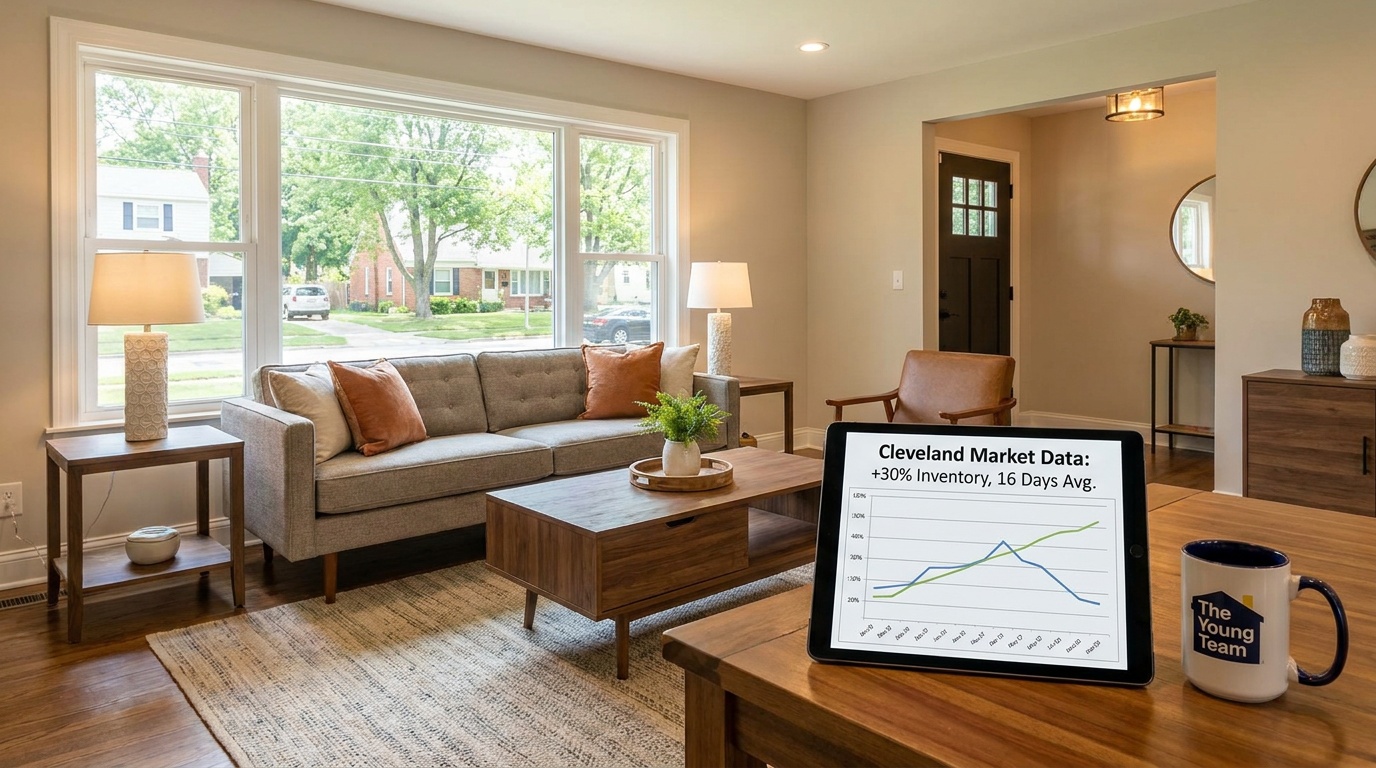
Precision Beats Patience: 30% More Homes, Still Only 16 Days to Contract
Key Takeaways: Inventory Up, Speed Still Fast
- Northeast Ohio inventory is up approximately 30% year over year, yet well-priced homes are still going under contract in approximately 16 days.
- The gap between headline supply and street-level speed reveals a pricing and positioning problem, not an inventory problem.
- Not all new supply is equal. Much of the added inventory sits above fair market value or in slower price bands where buyer demand is thinner.
- The first 14 days on market are decisive. Motivated buyers are front-loaded. Miss that window and you spend weeks chasing interest you should have captured in week one.
- Neighborhoods and price points move at very different velocities. Inner-ring suburbs near strong school districts contract faster than outer-ring exurbs.
- Positioning beats waiting. In a roughly 30% supply environment, being first to market at the right price outperforms holding out for fewer competitors.
- Buyers and sellers alike are misreading the market because they see supply numbers, not buyer behavior.
More Homes Listed. Yet the Best Still Vanish in Two Weeks. Here's Why.
Open any Cleveland housing dashboard right now and you'll see something that looks like good news for buyers and breathing room for sellers: inventory up roughly 30% year over year across Northeast Ohio. More choices. Less pressure. Right?
Not quite. Zillow's Cleveland metro data shows median days to pending hovering around 16 days for competitively positioned homes, even as overall supply climbs. The best homes, priced at or near fair market value, are still drawing multiple showings in week one and accepted offers by week two. Meanwhile, many homes that entered the market above value are sitting significantly longer.
So what explains the contradiction? The answer is not the market. It's the math inside the market. A roughly 30% inventory increase sounds like a rising tide, but the additional supply is not evenly distributed across price points, condition levels, or neighborhoods. Two very different buyer experiences are happening simultaneously, and which one you get depends almost entirely on how you enter the market.
Precision beats patience. That's the core truth of Northeast Ohio real estate right now, and this article breaks down exactly what the data shows, where velocity is high and where it's stacking up, and what buyers and sellers need to understand before making a move.
The Supply Paradox: More Homes, But Where Are They?
Here's the data story worth understanding. Inventory across the seven-county Northeast Ohio market (Cuyahoga, Geauga, Summit, Stark, Lake, Lorain, and Portage) is up compared to a year ago. Realtor.com's Cuyahoga County market data confirms the rise in active listings alongside a notable share of price-reduced homes, which tells you something important: a portion of that supply entered overpriced and is now correcting.
The overall average days on market in Northeast Ohio varies depending on county and price band. But averages can be misleading. They blend two very different outcomes. Well-priced homes are going under contract relatively quickly. Overpriced homes are sitting significantly longer, collecting price cuts, and ultimately closing below where they would have landed if they'd been priced correctly from the start.
Many analysts and market observers suggest the lower price ranges remain the tightest. That's where buyer demand concentrates, where first-time buyers compete with move-up sellers, and where condition and presentation directly determine speed. At higher price points, more inventory appears to be stacking, particularly in outer-ring suburbs where supply has grown faster than buyer demand.
Greater Cleveland Partnership data adds a piece of context that explains why the speed hasn't collapsed: Cleveland has seen strong year-over-year price appreciation among major U.S. metros. That signals sustained buyer demand, not a market running out of steam. Outside interest in Cleveland as an affordable, appreciating market is still a factor keeping well-positioned homes competitive.
The practical takeaway: more homes on the market does not mean every home sells faster. It means the market is sorting inventory into two tiers, fast and slow, and pricing is the primary sorting mechanism.
The First 14 Days: Why Positioning Beats Waiting for Better Inventory
There is a window after every listing goes live that determines most of what follows. Understanding how it works is arguably more valuable than any market prediction.
When a home enters the market, the buyers most likely to pay full price or above are actively browsing in that first two-week period. They have alerts set, they're scheduling showings within days of a listing going live, and they're prepared to submit offers before anyone else does. As our breakdown of why buyer demand peaks early explains, buyer activity is front-loaded. Once that initial pool moves on, the buyers who remain often use extended days on market as leverage to negotiate the price down.
This is why the 14-day window is not a fluke. It's a function of buyer psychology and search behavior.
What Happens When Pricing Is Off by 5%
A home priced above fair market value does not attract slightly fewer offers. It often attracts dramatically fewer showings because buyers filter by price range and your listing falls into the wrong bucket. Buyers who do see it note the discrepancy between the price and comparable sales, and they move on. After two weeks of light traffic, the perception shifts. Buyers assume something is wrong with the home, even when the only issue is the ask.
Many homeowners find the penalty compounds every week. Pricing accuracy for Cleveland sellers is not a small variable. It is the variable. Many sellers are already close to market value when they list. A list price even a few percentage points above that range places you outside the band buyers are searching, and no amount of beautiful photography recovers that ground.
Why Presentation Is the Second Variable
In a market with more homes, buyers can afford to be selective. According to the National Association of Realtors, listings with professional photography receive significantly more online views and schedule more showings than those with smartphone images. A listing with professional photos, an accurate and specific description, and strategic online positioning gets scheduled. A listing with low-quality photos gets scrolled past. Presentation does not replace pricing, but in a crowded market, it determines whether a correctly priced home captures its full buyer pool or a fraction of it.
In short, the sellers who thrive in this environment are the ones who treat day one as the only day that matters.
How Cleveland Neighborhoods Are Moving at Different Speeds
The 16-day headline applies to a specific kind of home in a specific kind of location. Zoom into the street level and the picture is more nuanced.
Inner-Ring Suburbs: Still Competitive
Shaker Heights, Beachwood, Cleveland Heights, and University Heights are among the fastest-moving submarkets in the metro. Homes in these areas, particularly those near Shaker Heights City Schools, Beachwood City Schools, and Orange City Schools, are regularly going under contract quickly when condition is solid. Local market reporting from Cleveland confirms this: attractive, well-priced homes in Parma, Lakewood, and North Ridgeville are drawing multiple offers within the first two weeks, consistent with what we're tracking across the metro.
These areas attract buyers who commute to University Circle, downtown Cleveland, and the medical corridor. Walk scores, proximity to Rapid Transit access, and established neighborhood character drive consistent demand.
Outer Ring and Exurbs: Inventory Stacking
Geauga, Stark, and outer Lorain County are seeing a different story. Based on transaction patterns our team is actively tracking across these counties, signals suggest inventory is rising faster than buyer demand. Typical timelines for well-positioned homes are running longer, and that gap extends further for homes with condition or pricing issues. Homes.com market data for Cleveland confirms that even metro-wide averages obscure meaningful submarket variation, and our on-the-ground tracking aligns with that pattern.
This doesn't mean these markets are cold. It means buyers there are selective. They want move-in ready. They want accurate pricing. And they have more options to compare against.
First-Time Buyer Zones: Speed Requires Condition
Tremont, Collinwood, and west Lakewood remain active for first-time buyers, particularly at lower price points. But condition is the price of admission. Homes that need significant work are not moving at the same pace as turnkey options in the same price range. Homes.com market data for Cleveland reinforces that even Cleveland's lower price points close relatively quickly, which surprises buyers who assume affordable means slow. It doesn't. It means you still need a strategy.
Move-Up Zones: Selective Buyers, Rising Standards
Summit County (Copley, Medina, and the Montrose area), along with Lake County lakefront properties, is seeing increased supply but selective buyers. Dual-income households shopping at higher price points have access to more choices than a year ago, and they're using that access. Homes that aren't move-in ready sit. Homes that are staged, properly priced, and near Hudson City Schools, Nordonia Hills, or Aurora City Schools continue to attract offers.
Commute-friendly areas near Cuyahoga Valley National Park, Kent, and Streetsboro are seeing increased interest from buyers who want space but need access to employment centers in Akron and Cleveland.
Well-Priced vs. Overpriced Homes: The Fast Sale vs. Extended Market Reality
The difference between a quick sale and a prolonged struggle is rarely location. Historically, it comes down to pricing accuracy, presentation, and offer positioning.
Note: The table below reflects observed market patterns from transactions tracked by The Young Team. It is not intended as financial, legal, or tax advice. Consult a licensed CPA, attorney, or lender for guidance specific to your situation.
| Factor | Well-Priced Home (92-98% of FMV) | Overpriced Home (103-110% of FMV) |
|---|---|---|
| Week 1 activity | 10-14 showings | 3-4 showings |
| Offer timeline | Multiple offers by day 9-12 | Feedback requests price drop |
| Contract date | Day 14-16 | Repriced at day 21-35 |
| Buyer perception | High demand, competitive | "Why hasn't it sold?" |
| Final sale outcome | At or above list | Below original list |
| Total days on market | ~16 days | 60+ days |
In a market with more supply, buyers are sorting faster, not slower. If a home is priced above the band buyers are filtering, it doesn't get seen. If it's seen and priced high, buyers move to the next option. The pool of motivated, full-price buyers does not wait. It moves.
Signals suggest the penalty for overpricing is higher in a supply-rich environment precisely because buyers have alternatives. In a tight inventory market, a buyer might stretch to overlook a high ask. With significantly more homes available, they simply don't have to. Precision beats patience. That's the current reality.
Market Questions Northeast Ohio Buyers and Sellers Are Asking Now
Inventory is up. So why are homes still selling so fast?
The supply increase is real, but it's not evenly distributed. Much of the additional inventory entered the market above fair market value or in price bands where buyer demand is thinner. The homes that are moving quickly are the ones priced accurately and presented well. In lower price ranges across Cuyahoga, Summit, and Lake counties, value is still scarce relative to demand. Buyers know it, and they move fast when they find it.
I'm thinking of listing. Should I wait for fewer homes on the market?
Signals suggest that waiting for lower inventory rarely produces the advantage sellers expect. In a higher-supply environment, being first to market with the right price and strong presentation is a more reliable strategy than holding out. The homes winning right now are not the ones that entered a less crowded market. They're the ones that entered correctly. Holding also has a cost: carrying expenses accumulate, and you may miss a high-demand season entirely.
How do I price my home to sell quickly rather than sit for months?
Start with a professional pricing analysis grounded in recent comparable sales, not what you need to net or what a neighbor listed for. Stage the home, photograph it with a professional, and write an accurate, specific listing description. Then watch the first 14 days closely. If you're not seeing showing requests within the first 3-5 days, the price is telling you something. Our Cleveland seller's pricing guide breaks down exactly how to read those early signals before they become a prolonged problem.
As a buyer, should I wait for more inventory to arrive?
Waiting doesn't guarantee better options. Signals suggest buyer demand for well-priced, well-maintained homes in strong school districts remains consistent, which means the home you're waiting on may attract the same competition whenever it arrives. If you find a home that fits your criteria and your budget, the stronger play is a prepared, well-structured offer rather than a delay strategy built on the assumption that tomorrow's inventory will be easier.
Which neighborhoods are moving fastest right now?
Inner-ring suburbs with strong school districts, including Shaker Heights, Beachwood, and Westlake, are among the fastest. First-time buyer price points in Tremont, Lakewood, and Parma move quickly when condition is solid. Outer-ring counties like Geauga and Stark are seeing longer timelines as inventory builds faster than demand. Price point and condition matter as much as location in determining how fast any specific home moves.
What's the biggest mistake sellers make in this market?
Overpricing and underinvesting in presentation. Both add weeks to days on market, and in a higher-supply environment, those weeks are expensive. Every additional week on market means more carrying costs, more negotiating leverage for the buyer who eventually shows up, and a price reduction that signals hesitation to every buyer who sees it. The sellers who win treat day one like it's the only day that matters, because historically, it is.
Why Positioning and Speed Matter: The Young Team Approach
Understanding the market gap is one thing. Navigating it well is another.
The Young Team at Keller Williams Greater Metropolitan operates on a specialist model built for exactly this kind of market. When you list with us, you're not working with a solo agent juggling every role. A dedicated listing coordinator, a marketing specialist, and a closing coordinator each handle their piece, which means your home enters the market correctly priced, professionally photographed, and positioned with a clear strategy from day one. That's how you capture the 14-day window instead of chasing it.
With $1B+ in career sales across seven Northeast Ohio counties, the team has built real-time pricing intelligence at the submarket level. We know what's moving in Beachwood versus Medina, what buyers in Geauga County are accepting on inspection, and which price bands are generating multiple offers right now. Closing 500+ families a year means that data is live, not historical. And 1,400+ five-star reviews reflect the 6-star experience we hold every transaction to: not just satisfied, not just delighted, but forever clients who trust us long after closing day.
That post-close relationship is not a tagline. Through Forever Client Care, we stay connected with market updates, contractor referrals, and proactive outreach so that when your next move comes, you're not starting over with someone new. You're calling the team that already knows your home, your goals, and your neighborhood.
Our Worry-Free Listing program handles the positioning, marketing, and offer strategy so you're not guessing at any step, from professional photography to pricing analysis to negotiation support. For sellers who want more certainty upfront, our Guaranteed Cash Offer program provides a clear path forward without the uncertainty of an extended wait. In a market where more homes are competing for buyer attention, speed and strategy are what separate clients who thrive from those who watch the right opportunity pass.
Precision beats patience. We're here to make sure you're on the right side of that line.
Ready to Navigate This Market Right?
Whether you're buying or selling in Northeast Ohio, the first 14 days matter. The Young Team at Keller Williams Greater Metropolitan has guided over 1,000 families through this exact market dynamic.
Let's talk about your timeline and your strategy.
Call 216-378-9618, email terryyoung@theyoungteam.com, or visit theyoungteam.com. You're also welcome to stop by our office at 34105 Chagrin Blvd, Suite L, Moreland Hills, OH 44022.
This article reflects current market signals and publicly available data. It is not intended as financial, legal, or tax advice. Consult a licensed CPA, attorney, or lender for guidance specific to your situation.