
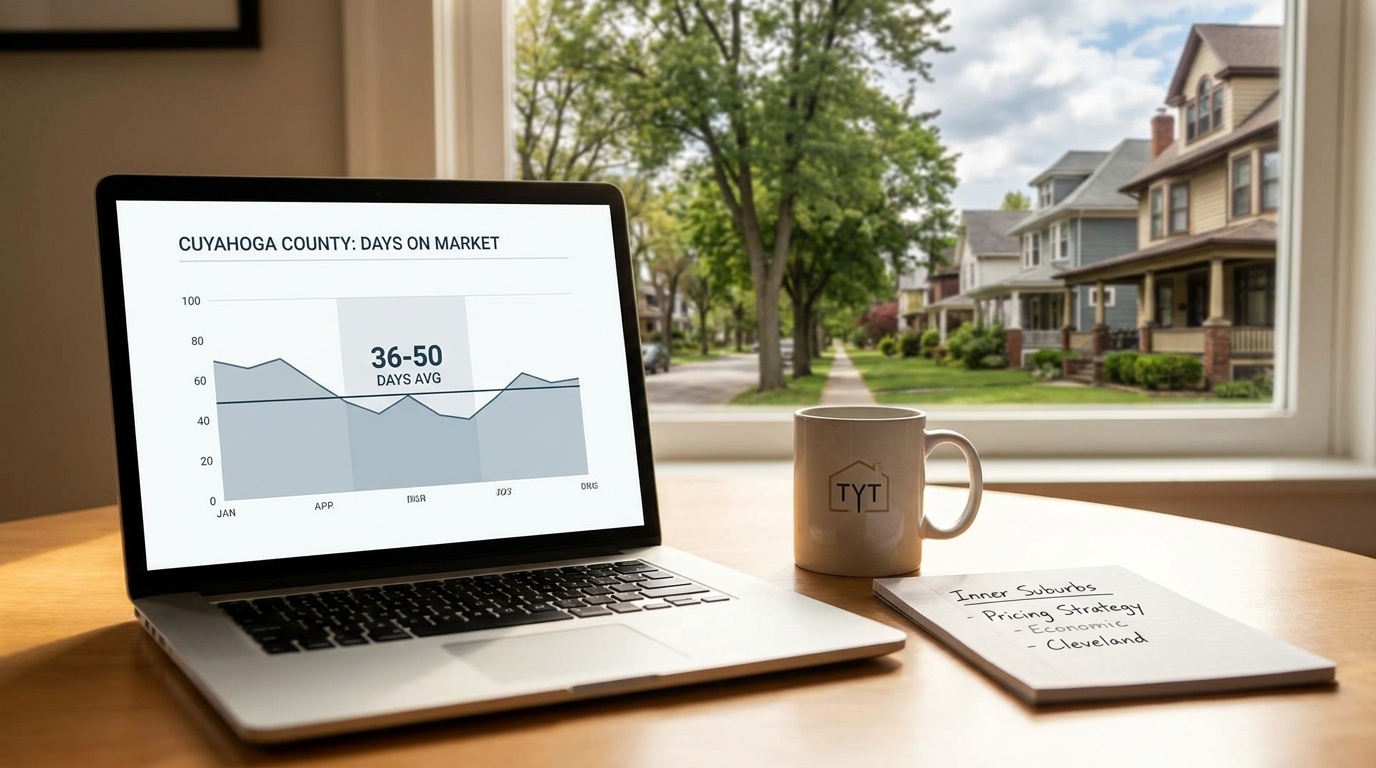
Cuyahoga County Days-on-Market Data Tells Sellers What Pricing Gets Wrong
Key Takeaways: Cuyahoga County Pricing and Days-on-Market
- Inner suburbs are averaging in the mid-40s on market in Cuyahoga County, according to data tracked across the region's most active move-up seller neighborhoods as of early 2026.
- Pandemic-era pace is gone. During 2021-2022, homes routinely went pending much faster than today. That window has closed, and sellers still pricing to those conditions are paying for it.
- Overpricing is the primary driver of extended market time, not buyer demand or inventory. Well-priced homes in Shaker Heights, Lakewood, and Rocky River continue to move relatively quickly.
- Accurate pricing produces better net proceeds. A home priced right on day one avoids buyer skepticism, inspection leverage, and price reductions that compound the final sale deficit.
- Closing costs matter to your real number. Sellers who price for gross proceeds rather than net proceeds often discover a gap at the closing table. Every extra day on market adds carrying costs.
- Move-up sellers carry double risk. A slow sale delays your purchase, creates bridge financing pressure, and can cost you the next home entirely.
- One clear next step: Get a pricing analysis from The Young Team before you list.
Why Cuyahoga County Sellers Are Missing Net Proceeds
You listed your home expecting it to move. Weeks are passing, showings are sparse, and the feedback coming back through your agent is vague. Meanwhile, you're watching another home two streets over go pending in ten days. The difference is almost certainly not the market. It's the price.
Move-up sellers across Cuyahoga County's inner suburbs are sitting on homes longer than expected in 2026, and a significant share are leaving money on the table by misreading the signals the data is sending. Redfin's current Cuyahoga County housing market data places the average days on market at 46 days, up from 41 days a year prior. That year-over-year increase is not random. It tracks directly with the share of listings priced above comparable sales.
The sellers who understand this dynamic get in and out faster, with stronger final numbers. The ones who don't often end up accepting offers below what accurate initial pricing would have produced, after carrying costs, buyer concessions, and the stigma of a stale listing have done their damage.
One Young Team forever client summarized what pricing discipline produced in practice: "We were nervous about pricing lower than we thought we could get, but the team walked us through the comps and explained exactly where buyers would draw the line. We listed, had showings immediately, and were under contract in two weeks. The net number was better than what we would have cleared after sitting on the market for two months."
This article explains what the data actually says, where the cost accumulates, and what a disciplined pricing strategy looks like across Cuyahoga County's most active communities.
What Cuyahoga County Days-on-Market Data Really Says
The headline number matters less than what it masks.
FRED's Cuyahoga County median days-on-market series shows a post-2022 expansion in market time, with data through Q4 2025 reflecting a median that has stretched into the mid-40s. During the peak of pandemic-era demand, Cuyahoga County homes were moving significantly faster in competitive neighborhoods. The sellers still anchoring to 2021 comparables are discovering that normalization the hard way.
The chart below illustrates how Cuyahoga County median days-on-market trended from 2021 through early 2026, based on FRED data. The post-2022 expansion is reflected in the data across multiple reporting periods.
Zillow's current Cuyahoga County data, updated through early 2026, shows days-to-pending metrics that many analysts use to examine the split between accurately priced homes and those requiring reductions. The pattern signals one thing: pricing discipline separates fast, clean sales from extended, eroded ones. Historically, markets in normalization punish overpricing with compounding speed.
What does elevated days-on-market actually signal? Three things. First, a pricing disconnect between seller expectations and buyer comparables. Second, a buyer pool that is comparing actively and walking away from listings they perceive as above market. Third, inventory levels high enough that buyers have options, which means your overpriced home is not being negotiated down. It is being skipped entirely.
Consider a concrete example. A home in a Cuyahoga County inner suburb where recent comparable sales cluster in a defined range signals overvaluation to every buyer who pulls those comps on their phone. That buyer does not negotiate down from an overpriced listing. They move to the next listing.
The Akron Cleveland Realtors housing data validates this pattern at the local trade level, showing days-on-market variation across inner-ring and outer-ring communities. And Cuyahoga County's community profiles establish the structural context: inner suburbs carry older housing stock, denser lot sizes, and more varied condition levels, all of which require more disciplined pricing than new-construction outer rings where buyers adjust for upgrades uniformly.
Why this matters now: the sellers contributing to the 46-day average are largely still correcting. The sellers who went pending quickly priced right on day one. As the internal Young Team analysis makes clear, your first list price sets the entire trajectory of a sale, and that trajectory is nearly impossible to fully recover once it starts sliding.
Why Accurate Pricing Saves More Than Time
Every additional day your home sits on the market carries a cost. To make this concrete: on a $400,000 home with a typical Northeast Ohio mortgage balance, daily mortgage interest, property tax accrual, utilities, and homeowners insurance can add up to meaningful carrying costs over an extended listing period. Many homeowners find that an extra 30 days on the market runs into thousands of dollars in direct carrying costs alone. Consult your lender for the precise carrying cost on your specific mortgage.
But carrying costs are only the visible part. The deeper damage comes from buyer psychology.
A home that has been listed for 45 days triggers a question in every buyer's mind: what's wrong with it? The answer they assume is rarely kind. Buyers interpret extended market time as a signal of either overpricing or condition problems, and both interpretations push them toward lower offers or away from the listing entirely. Internal Young Team analysis of the most common pricing mistakes Cuyahoga County sellers make shows that a home overpriced by even 5% often requires a 6-8% reduction to reset buyer perception, and that reset rarely recovers what accurate initial pricing would have captured.
The compounding effect hits hardest at inspection. Buyers who feel they've already waited for a price reduction approach inspections looking for additional leverage. Items that would have been absorbed in a competitive offer become negotiating tools. Concessions on closing costs, repair credits, and price adjustments stack on top of the reduction you've already made.
The math is not complex. It's just uncomfortable. Gross proceeds minus carrying costs, minus buyer concessions, minus closing costs equals net proceeds. Sellers who understand closing costs and structure their pricing around that net target, rather than a gross asking number, consistently walk away with more. This is where precision pricing intersects with financial literacy, and why every conversation about listing price has to start with what you actually need to clear.
What Sellers Should Avoid Before They List
The data is clear on what works. It's equally clear on what does not.
Pricing based on hope instead of data. The most common mistake move-up sellers make is anchoring to what they wish the home were worth, what a neighbor claimed they got, or what the market looked like in 2022. None of those are comparables. The only number that matters is what a buyer paid, at closing, for a home similar to yours, in your neighborhood, in the last 30-60 days.
Accepting the first offer without context. A fast offer is not automatically a low offer, but it should still be evaluated against current comps and your net proceeds target. Sellers who reject quick offers reflexively, assuming a higher bid will follow, sometimes find themselves with a stale listing instead. Evaluate every offer against the data, not the assumption that more time will produce more money.
Relying on automated valuation estimates alone. Zillow Zestimates and similar tools use broad inputs and lag real-time transaction data. They are a starting point for curiosity, not a substitute for a neighborhood-level comp analysis from an agent who has closed transactions in your specific submarket recently.
Waiting for a market shift that may not arrive on your timeline. Signals suggest 2026 Cuyahoga County conditions will continue to reward accurate pricing. Waiting for rates to drop or inventory to tighten before listing, while planning to price above market, combines two uncertain bets into one strategy. Historically, accurate pricing in any market condition outperforms aspirational pricing in a favorable one.
Cuyahoga County Communities: What the Data Means for Your Neighborhood
Cuyahoga County is not a single market. Days-on-market and pricing behavior vary meaningfully across communities, and treating the county as uniform is one of the first mistakes a move-up seller can make.
Shaker Heights draws buyers looking for early 20th-century architecture, walkable streetcar-era neighborhoods, and direct access to Cleveland's cultural corridor. Well-maintained, accurately priced homes in the $350,000-$550,000 range are moving relatively quickly based on current signals. Overpriced homes in Shaker, however, sit visibly longer. Buyers in this market compare aggressively against recent sales, and homes priced above the most recent three comparables face direct rejection, not negotiation. To illustrate: a 1920s Colonial in Shaker Heights with updated kitchen and original hardwoods, where recent comparable sales closed in a defined range, that enters the market significantly above that range will face immediate buyer filtering. The same home priced in alignment with the comp cluster signals value and draws early showing traffic.
Lakewood remains one of the county's most active inner suburbs for buyers prioritizing walkability, dining corridors along Detroit Avenue, and shorter commute distances to downtown Cleveland. At lower price points, condition is the price of entry. A move-in-ready Lakewood home priced accurately can still generate multiple showing requests in the first week. An outdated home at the same price with deferred maintenance will sit well beyond the county average regardless of neighborhood demand. A well-maintained 1940s bungalow needs to enter the market within the band established by recent comparable sales, not above it, to avoid being filtered out of buyer searches entirely.
Rocky River and Westlake attract move-up buyers in the $400,000-$600,000 band, often dual-income households upgrading from first homes. In Westlake, accurate pricing relative to recent sales in comparable subdivisions drives the difference between fast and slow outcomes. Buyers here are conducting detailed comp analysis before submitting any offer, and a listing priced above the cluster of recent sales will be filtered out of searches entirely.
Euclid and outer Cuyahoga County communities present a different dynamic. In Euclid, price sensitivity is sharper, buyer optionality is higher, and the cost of overpricing accelerates more quickly. Homes here that miss the accurate price band by even 3-4% tend to accumulate days-on-market at a faster rate than inner suburbs, because the buyer pool at those price points compares more broadly across adjacent communities.
Parma and the southwest corridor complete the county's geographic picture. Parma consistently ranks among Cuyahoga County's highest-volume zip codes by transaction count. Buyers in the $180,000-$280,000 range here are highly price-sensitive and actively comparing across Parma, Parma Heights, and Brook Park. A home that enters the market even 4-5% above the tightest comparable cluster in this corridor will be filtered out immediately by buyers who have identified multiple alternatives at or below that level. Accurate pricing in Parma is not about leaving money behind. It's about being present in the buyer's search in the first place.
The Cuyahoga County community profiles maintained by the county planning office document the housing stock characteristics that explain these patterns: older build years, varied lot sizes, and structural diversity that makes cookie-cutter pricing strategies unreliable. Neighborhood-specific pricing analysis is not optional in this market. It's the foundation.
How 2026 Market Conditions Are Reshaping Pricing Strategy
The Cuyahoga County market in 2026 is not operating under the same dynamics that governed 2021 or even 2023. Three shifts have converged to make pricing discipline more consequential than at any point in the post-pandemic period.
Inventory has normalized. Buyer optionality has returned. In 2021, buyers competed for every available listing. In the current environment, a buyer who perceives your home as overpriced has alternatives. That shift alone changes the calculus for sellers who entered the market expecting low inventory to cushion a high list price.
Rate-adjusted buyer budgets are tighter. Buyers who got pre-approved in 2021 at 3% rates were qualifying for significantly larger purchase prices than buyers approved at today's rates. The same household income now qualifies for a smaller mortgage, which means the price ceiling for a given buyer is lower. Sellers pricing to 2021 sale prices are often pricing above what today's qualified buyer pool can reach. Your lender can walk you through what this means for your specific buyer target.
Sellers who need to move are competing with sellers who don't. An increase in voluntary move-up activity combined with some distressed and estate listings means buyers are comparing your home against a more varied inventory mix. A well-priced home stands out not just on price but on presentation, and the sellers who combined accurate pricing with strong marketing in early 2026 are the ones generating first-week showing traffic.
The FRED days-on-market data through Q4 2025 reflects this environment: the normalization that began post-2022 has continued, and signals suggest it will reward sellers who price from current transaction data, not from memory.
Overpriced vs. Accurately Priced: What the Numbers Show
The difference between pricing right and pricing aspirationally shows up most clearly in final net proceeds, not just days on market. The table below models outcomes for a home in the $400,000-$445,000 price range. Sellers at different price points should scale these figures proportionally; the percentage relationships between overpriced and accurately priced outcomes are consistent across most Cuyahoga County submarkets.
| Factor | Overpriced Home | Accurately Priced Home |
|---|---|---|
| Asking Price | $445,000 | $425,000 |
| Average Days on Market | 45+ days | 18-22 days |
| Price Reduction Required | Yes, $15,000-$20,000 | No |
| Buyer Concessions (inspection, closing) | $5,000-$8,000 | $1,500-$3,000 |
| Final Sale Price | ~$410,000-$415,000 | ~$418,000-$422,000 |
| Carrying Costs (extra 25+ days) | $750+ | Minimal |
| Appraisal Risk | High (appraiser sees overpricing history) | Low |
| Net Proceeds to Seller | ~$390,000-$395,000* | ~$400,000-$404,000* |
| Net Proceeds Difference | +$8,000-$10,000 for accurate pricing |
*Estimates after standard Northeast Ohio closing costs, conveyance fees, and agent commission. These figures model a home in the $400,000-$445,000 range; sellers at higher or lower price points should adjust proportionally. Consult your CPA or attorney for your specific transaction. Consult your lender for carrying cost calculations specific to your mortgage.
The Redfin data for Cuyahoga County reinforces this pattern, showing that homes selling above versus below list price track directly with initial pricing accuracy. Homes priced at or slightly below recent comparable sales go under contract faster and close closer to list price. The overpriced home in this table did not earn more by starting higher. It earned less, while taking longer to get there.
The Zillow days-to-pending metric reflects a split in market performance: accurately priced homes transition to pending status more quickly than homes that require reductions. Every week of that gap is a week where buyer enthusiasm is declining and negotiating leverage is shifting away from the seller.
Move-Up Sellers Who Got It Right
The sellers who come out ahead in this market share one consistent trait: they priced from the data, not from what they hoped the home was worth.
Another move-up seller, navigating the coordination of selling and buying simultaneously, noted: "What made the difference was understanding that every extra week on the market was costing us money and delaying our purchase. Pricing accurately wasn't leaving money behind. It was capturing it."
These outcomes are not accidental. They reflect a pricing discipline grounded in real transaction data across Northeast Ohio.
The Young Team Worry-Free Listing Program: Built for This Market
Move-up sellers in Cuyahoga County are managing a high-stakes coordination problem: sell accurately, sell fast, and time the purchase without getting stuck carrying two homes or none. The Worry-Free Listing Program exists precisely for this moment.
The program addresses three risks that define the current market.
First, pricing accuracy from day one. The Young Team prices from real-time transaction data across Northeast Ohio, anchoring your list price to what buyers are actually paying in your specific submarket, not a regional average. The methodology starts with sold comparables from the last 30-60 days within your neighborhood, adjusted for square footage, condition, and feature differences. That analysis is cross-referenced against active competition and days-on-market trends by price band to identify exactly where buyer demand clusters. The result is a list price range grounded in where buyers are drawing the line today, not where a seller hoped the market would be.
Second, coordinated marketing designed to compress days-on-market. A dedicated marketing specialist handles professional photography, digital presentation, and syndication to Zillow, Redfin, and Realtor.com, so your listing enters the market positioned to capture the early buyer window where motivated, qualified buyers are most active.
Third, transaction coordination that manages the sale-and-purchase timeline without letting either side fall apart.
The specialist model behind every listing includes your dedicated agent, a listing coordinator, a closing coordinator, and the marketing specialist. Each person owns their role. No dropped balls. No single agent juggling every task at 11 PM.
Over 1,400 five-star reviews reflect what that structure produces in practice. Forever Client Care extends the relationship beyond closing, because the team's goal is a forever client, not a completed transaction. The mission is straightforward: deliver a 6-star experience that goes beyond satisfied, into delighted. In a market where pricing discipline and execution speed determine net proceeds, that mission has a concrete dollar value for every seller who goes through the program.
Move-Up Sellers Ask: Days-on-Market, Pricing, and Next Steps
How do I know if my home is priced correctly for the current Cuyahoga County market?
Start with sold comparables from the last 30 days, not Zillow estimates or what a neighbor got in 2022. Your home's value is what similar homes in your specific neighborhood actually closed for recently. Three to five sold comps within 10% of your square footage, similar condition, and same general location give you a reliable anchor. If your current price is above the top of that range without a clear condition or feature advantage, signals suggest it's too high.
What does 40 days on market tell me about my pricing?
It tells you the market has already given you its answer. Buyers compared your home to competing listings and recent sales, found it above market value, and moved on. At day 40, you've likely already missed the most motivated buyer pool from your first two weeks. The question now is whether to reduce decisively to reset buyer perception or continue accumulating days-on-market while carrying costs grow. Historically, a prompt correction outperforms a slow one in both final price and time to close.
How much does each extra day on the market cost me?
Many homeowners find that direct carrying costs — mortgage interest, property taxes, utilities, and insurance — add up meaningfully over 30 extra days, often running into hundreds of dollars before accounting for the buyer concessions, inspection credits, and negotiating leverage that an extended listing typically produces. The indirect costs frequently exceed the direct ones. Consult your lender for the precise carrying cost on your specific mortgage.
Should I wait for spring to list, or price accurately now?
Seasonal timing matters less than pricing accuracy. A correctly priced home in January historically outperforms an overpriced home in April. The buyers who are active in the current market are motivated, they're comparing comps in real time, and they will move quickly on a well-priced listing. Waiting for spring while planning to list above market value combines the worst of both strategies. The FRED days-on-market data for Cuyahoga County shows the post-2022 normalization reflected across multiple reporting periods.
How does my pricing strategy affect my ability to buy the next home?
Directly. An overpriced listing that sits 45 days before going under contract delays your closing by 45 days, compresses your window to make a competitive offer on your next home, and can force bridge financing conversations that add cost and complexity. Move-up sellers who price accurately and close on a defined timeline have far more control over the purchase side of the transaction. Speed on the sale side creates leverage on the buy side.
What should I do if my home has already been on the market 45 or more days without offers?
First, get a fresh comp analysis. Pull every sale from the last 30 days in your immediate neighborhood and compare directly to your current list price. If your price sits above the top of that comp cluster, the data is telling you what buyers already know. A decisive price reduction, moving your list price to the midpoint or lower end of recent comps rather than splitting the difference, gives you a genuine reset. Re-engage your marketing: refresh the photography if it's more than 45 days old, update the listing description, and push the repriced listing to Zillow and Redfin as a new price event. Buyers tracking your home will receive an alert. A stale listing with a modest reduction rarely triggers action. A repriced listing backed by refreshed marketing can recover the early-buyer energy that launched with your original list date. Consult your agent on the specific reduction needed in your submarket.
What role does marketing play in reducing days-on-market?
Marketing drives initial showing volume, and initial showing volume determines whether you capture the early buyer window. Professional photography, accurate listing data, and well-executed syndication to Redfin and Zillow get qualified buyers through the door in the first week. On every Young Team listing, a dedicated marketing specialist owns this work exclusively, handling photography coordination, listing presentation, and digital syndication without splitting attention across other transaction tasks. Marketing cannot fix an overpriced home, but it amplifies an accurately priced one. Pricing gets buyers to look. Marketing gets them through the door.
Get Your Cuyahoga County Home Priced Right
Accurate pricing is the highest-leverage move you can make before listing. It determines your days-on-market, your buyer pool, your final sale price, and your ability to move on to the next home on your timeline.
The Young Team's pricing analysis is grounded in real transaction data from Northeast Ohio, not algorithms. Connect with the team to get a clear picture of where your home stands in the current market and what accurate pricing actually produces in net proceeds.
Call: 216-402-4774 Email: terryyoung@theyoungteam.com Website: theyoungteam.com Office: 34105 Chagrin Blvd, Suite L, Moreland Hills, OH 44022