
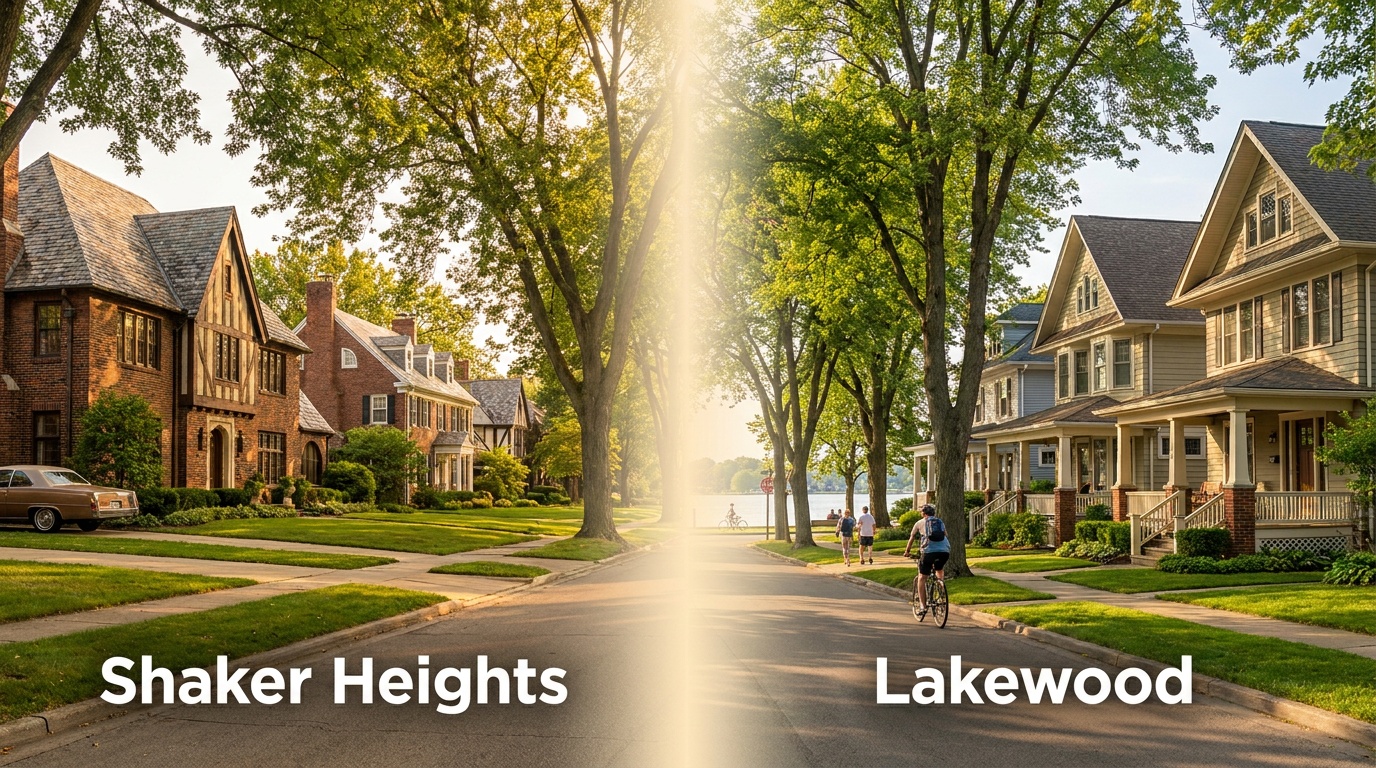
Shaker Heights vs. Lakewood: Which Cleveland Suburb Fits Your Life in 2026?
Quick Takeaways: Shaker Heights vs. Lakewood
- Shaker Heights architecture features English Tudors, Georgian colonials, and mid-century homes built by the Van Sweringen brothers on generous, tree-lined lots.
- Lakewood housing stock runs mid-century ranch, Cape Cod, and bungalow styles, with a typical price range of approximately $280K–$480K.
- School districts differ sharply: Shaker Heights City School District carries a strong academic reputation; Lakewood City Schools is an established district with strong community investment, arts programming, and specialized K-12 electives.
- Commute comparison: Shaker Heights sits roughly 20–25 minutes from downtown Cleveland via RTA rapid transit or US-422; Lakewood is approximately 20–25 minutes via I-90.
- Walkability: Shaker Square and the Van Aken District give Shaker Heights a pedestrian-friendly commercial core; Lakewood's Detroit Avenue corridor and Lakewood Park offer lake access and streetside dining.
- Market pace: Both are inner-ring suburbs, meaning condition and pricing drive speed; well-priced, move-in-ready homes in both communities historically go under contract faster than outer suburban counterparts.
- Who chooses Shaker: Relocating professionals targeting school access, walkability, and architectural character.
- Who chooses Lakewood: Budget-conscious move-up buyers, lake-access seekers, and first-time buyers wanting urban amenities at a lower entry point.
Choosing Between Two Cleveland Favorites
You've narrowed it down to two communities, and you're stuck. Both Shaker Heights and Lakewood sit just minutes from downtown Cleveland. Both offer inner-ring character that newer suburbs can't replicate. Both attract buyers who want real neighborhoods with real history, not cul-de-sacs and vinyl siding. So why does the choice feel so hard?
Because they're genuinely different. The right suburb for you depends on what you actually value. Shaker Heights and Lakewood answer different lifestyle questions, attract different buyer profiles, and carry different price tags and market dynamics. Relocating professionals on tight timelines, move-up sellers coordinating a simultaneous purchase, and first-time buyers weighing schools against affordability all face this exact fork in the road.
This guide breaks down both communities on neighborhood feel, school districts, home styles, pricing, commute logistics, and 2026 market behavior. By the end, you'll have enough specifics to decide which community deserves your Saturday afternoon showing.
Shaker Heights: Historic Walkability, Established Schools
Shaker Heights was developed as a planned streetcar suburb in the early twentieth century, a fact that still shapes nearly everything about it today. As Britannica documents, the Van Sweringen brothers laid out Shaker Heights with deliberate architectural controls and wide tree-lined boulevards. Rapid transit integration has been a feature of the community since its early development, and today the Shaker Rapid connects residents directly to downtown Cleveland without a car, a feature that few Northeast Ohio suburbs can match.
The neighborhood feel is distinctive. Chagrin Boulevard and South Woodland Road frame brick colonials, English Tudors, and center-hall homes on lots that often exceed a quarter acre. Shaker Square anchors the northwest edge of the city with retail, restaurants, and a farmers market. The newer Van Aken District adds mixed-use development, dining, and a renovated rapid transit hub at the community's center.
Larger lots in Shaker Heights bring architectural character, but they also mean more lawn care and seasonal maintenance compared to Lakewood's more compact street grids. That trade-off is worth factoring into your total cost of ownership, especially if you're moving from a lower-maintenance property.
Shaker Heights City School District carries a strong academic reputation and is frequently cited as a primary relocation driver for out-of-state families moving to Greater Cleveland. Shaker Heights High School, along with Woodbury and Onaway elementary schools, regularly draws buyers who are specifically targeting this district before they've even set foot in the city.
Commute times to downtown Cleveland run approximately 20–25 minutes by car via US-422 or I-271, and many commuters find the RTA Green or Blue Line a practical car-free alternative. For professionals commuting to University Circle, the ride is even shorter.
Many homeowners find that Shaker Heights attracts established professionals, academics, and out-of-state relocators who want architectural character, transit access, and a school district they can count on. Larger colonials and historically significant homes can push above $700K. The housing stock is older, which means buyers should budget for updates alongside the purchase price. Many buyers find it useful to reserve a portion of their budget for cosmetic updates on homes in this vintage range, though a thorough inspection will sharpen that number. Homes built between 1920 and 1960 commonly surface issues including aging knob-and-tube or aluminum wiring, cast-iron or clay sewer lines, original plaster walls, and outdated HVAC systems. None of these are automatic deal-breakers, but knowing what to look for before you write an offer helps you budget realistically and negotiate from a stronger position. BestPlaces data (updated Q1 2026) shows Shaker Heights carrying a higher median home value than Lakewood, reflecting both lot size and district demand.
Ohio's property tax structure differs by school district, and Shaker Heights' strong district rating is reflected in its millage. Consult a CPA on your specific scenario before finalizing your budget.
One recent client, a physician relocating from Pittsburgh to University Circle, chose Shaker Heights specifically for the RTA Green Line access and the school district boundary that covered her two school-age children. She was under contract within two weeks of her first showing.
If you love the east-side inner-ring character here but want to stretch your budget further, our guide to South Euclid, University Heights, and Lyndhurst covers comparable walkability and school quality at lower price points.
Lakewood: Affordability, Diverse Housing Stock, Lake Access
Lakewood sits directly west of Cleveland along the Lake Erie shoreline, and that geography shapes daily life there. Lakewood Park runs along the bluff above the lake, offering walking paths, sports fields, and views that most Ohio suburbs simply don't have. The Detroit-Shoreway corridor on the eastern edge of the city connects Lakewood residents to Cleveland's arts district, adding an urban energy that spills naturally into Lakewood's own restaurant and bar scene.
The housing stock here differs meaningfully from Shaker Heights. Lakewood's residential streets are lined with ranch homes, Cape Cods, brick bungalows, and two-family homes, many of which reflect a mix of owner-occupied and rental inventory. According to BestPlaces (updated Q1 2026), Lakewood has a notable rental population, which speaks to its appeal as a transitional community where buyers often upgrade from renting locally or from nearby Cleveland neighborhoods. A higher share of rental properties in any neighborhood can mean more variable maintenance investment property to property, so buyers should review condition carefully during inspection rather than assuming block-level uniformity. Compact lots also mean lower ongoing upkeep than Shaker Heights' larger parcels, which is a practical advantage for buyers who want more walkability and less yard work.
Lakewood City Schools serves the district with a K-12 system that includes Lakewood High School and several well-regarded elementary programs. The district is known for strong arts programming, including dedicated visual arts and performing arts tracks at the high school level, and for a community investment model that has sustained elective offerings even as many comparable districts have scaled back. Niche's 2026 Cleveland-area suburb rankings show Lakewood scoring well on nightlife and diversity, while its public school grades reflect a solid but different academic profile than Shaker Heights. Families are encouraged to research specific programs, speak with the district directly, and visit schools before making school access a primary decision factor.
Commute to downtown Cleveland from Lakewood runs approximately 20–25 minutes via I-90 East. The direct interstate connection makes Lakewood a natural target for downtown Cleveland professionals and healthcare workers tied to the Westside Medical Center corridor.
Home prices in Lakewood typically run from approximately the high $200Ks to the mid-$400Ks, with BestPlaces data (updated Q1 2026) confirming a lower median home value compared to Shaker Heights. Lot sizes are generally smaller, and home square footage trends more modest, but the price-per-square-foot equation often favors buyers looking for move-in-ready condition at an accessible entry point.
Lakewood falls under Cuyahoga County's property tax structure, and your millage rate will differ from Shaker Heights. Consult a CPA on how school district taxes factor into your total monthly cost before comparing the two communities on price alone.
If budget is a primary driver and both communities feel out of reach, our guide to Cleveland suburbs with homes under $250K in 2026 covers additional Cuyahoga County options with strong commute access.
Lakewood attracts first-time buyers, renters converting to ownership, and move-up buyers who want lake proximity and urban energy without Shaker Heights price tags. One first-time buyer we worked with had been renting in Ohio City and wanted to stay close to the lake. She found a move-in-ready Cape Cod in Lakewood at the lower end of the price range, closing with room left in her budget for furnishings rather than repairs.
Side-by-Side: How They Compare
| Category | Shaker Heights | Lakewood |
|---|---|---|
| Home Styles | 1920s–1960s colonials, Tudors, center-halls | Ranch, Cape Cod, bungalow |
| Typical Price Range | Consult current market reports for active ranges | ~$280K–$480K |
| Median Home Value | Higher (per BestPlaces, Q1 2026) | Lower (per BestPlaces, Q1 2026) |
| School District | Shaker Heights City School District (strong academic reputation) | Lakewood City Schools (established, arts-focused) |
| Commute to Downtown | ~20–25 min by car, RTA rapid transit available | ~20–25 min via I-90 East |
| Walkability | Shaker Square, Van Aken District, RTA rail | Detroit Avenue corridor, Lakewood Park, lake access |
| Lot Sizes | Larger, often quarter-acre or more | Smaller, more compact street grids |
| Market Pace | Condition- and price-sensitive; competitive for move-in-ready | Active for first-time buyers; condition drives speed |
| Owner vs. Renter Mix | Higher owner-occupied rate | More mixed; notable rental population |
| Best Fit | Relocating professionals, school-driven buyers, architecture seekers | First-time buyers, lake access seekers, budget-conscious move-ups |
Both communities sit in Cuyahoga County, both are served by established municipal infrastructure, and both attract buyers who specifically want inner-ring character. The difference comes down to your price ceiling, your school priorities, and whether you'd rather walk to a rapid transit platform or a lakefront park.
What's Happening in 2026: Inner-Ring Market Dynamics
Northeast Ohio's broader market is carrying more inventory in 2026 than in recent years, but that headline number masks what's happening at the street level. The inner-ring suburbs, including Shaker Heights and Lakewood, are behaving differently than outer-ring communities.
As market analysis on Cleveland's inventory trends documents, inner-ring pockets have shown notably tighter contract timelines than the broader county average. Signals suggest that well-positioned homes in desirable neighborhoods are still moving quickly, while overpriced or condition-challenged listings are sitting longer. The gap between those two outcomes is wider than it was two years ago.
In Shaker Heights specifically, pricing strategy matters at the front end. Homes priced at or near recent comparable sales have historically drawn stronger early interest, including multiple-offer situations in the first week. Overpricing reduces that momentum quickly. Lakewood shows a similar dynamic at its price tier: first-time buyers and condition-sensitive shoppers are active, but they're selective, and homes that need significant work are holding longer than move-in-ready alternatives.
Historically, inner-ring suburbs in Cuyahoga County have maintained demand resilience relative to outer suburbs because of transit access, commute efficiency, and proximity to Cleveland's major employment centers: University Circle, the Cleveland Clinic health corridor, and the downtown business district. Signals suggest that pattern is continuing into 2026, particularly as market analysis from CLE Moves tracks relocating professionals as a persistent buyer segment in both communities.
This is where micro-market knowledge matters. An agent who understands what sold on Coventry Road versus what sat on it, or what moved on Clifton Boulevard versus what didn't, can position your offer or your listing far more precisely than one who is working from county-level averages.
Why The Young Team for Your Shaker Heights or Lakewood Search
Most real estate teams hand one agent the entire transaction and hope nothing falls through the cracks. That model works fine until it doesn't, and in a competitive inner-ring market, "fine" isn't enough.
The Young Team operates on a specialist model. Every client works with a dedicated agent supported by a listing coordinator, a closing coordinator, and a marketing specialist. That means neighborhood-level knowledge stays sharp because no one person is stretched across every role. It also means that when a Shaker Heights Colonial gets a multiple-offer situation in day four or a Lakewood ranch inspection surfaces a surprise, there's a system behind your agent, not just one person improvising.
The team's career sales exceed $1 billion, with 1,400+ five-star reviews across Northeast Ohio. Clients consistently point to faster closings, fewer surprises at the table, and stronger negotiation outcomes as the markers that set this team apart. That depth of experience across Cuyahoga County, including extensive transactions in both Shaker Heights and Lakewood, means the team has seen the pricing dynamics, condition sensitivities, and negotiation patterns that define each community.
Signature programs include the Guaranteed Cash Offer for sellers who want speed and certainty without exposure to contingencies, the Worry-Free Listing for sellers who want expert preparation and full-market exposure, and Forever Client Care, which keeps the relationship active long after closing. You're not a transaction. You're a forever client.
The Young Team holds every transaction against a 6-star standard, not five. That bar shows up in 1,400+ reviews and in every interaction from first showing to final walkthrough. The team operates through Keller Williams Greater Metropolitan, combining the resources of one of the country's largest brokerage networks with the local depth that only a Northeast Ohio team built since 2003 can provide.
Choosing between Shaker Heights and Lakewood is just the first step. The team helps you move forward with confidence.
Common Questions About Shaker Heights and Lakewood
Which community is more affordable?
Lakewood typically offers a lower entry price. According to BestPlaces (updated Q1 2026), Lakewood carries a lower median home value than Shaker Heights. For buyers with a ceiling in the $280K–$380K range, Lakewood offers more options at that price point. Shaker Heights pricing tends to start higher due to lot size, housing age, and school district demand.
Which has better schools?
That depends entirely on what your child needs. Shaker Heights City School District carries a strong academic reputation and is frequently cited as a primary relocation driver for out-of-state families. It's a natural starting point if your child is in AP coursework or you're prioritizing college-prep programming. Lakewood City Schools is an established district with dedicated visual arts and performing arts tracks at the high school level. If your child is pursuing a focused arts pathway, visit Lakewood's specialized programs directly before relying on aggregate rankings. We'd recommend speaking with administrators at both districts rather than making a decision from a spreadsheet.
Which has a faster market right now?
Both move quickly when homes are priced correctly and in good condition. Inner-ring suburbs as a category historically move faster than outer-ring markets when inventory is well-positioned. In Shaker Heights, homes priced at or near comparable sales have historically generated strong early interest, including multiple offers in the first week. Lakewood's first-time buyer market is active but condition-sensitive. Your agent's pricing strategy matters more than which city you choose.
When is the best time to buy in each community?
Spring, typically March through May, brings the highest inventory volume in both communities, which means more choices but also more competition. Buyers who search in late fall or winter often find less competition and more negotiating room, though selection thins. For relocating professionals on a set timeline, either community can move quickly year-round when inventory is well-priced. The right time is when your financing is ready and you have an agent who knows what's moving in that specific neighborhood.
Which is better for renters transitioning to ownership?
Lakewood historically has a larger rental population, and the BestPlaces comparison (updated Q1 2026) reflects that mix. First-time buyers converting from local rentals often find Lakewood's lower price floor and urban walkability make it a natural first purchase. Shaker Heights ownership rates are generally higher, with buyers entering at a larger budget and longer time horizon.
What is the average home price in each community?
Lakewood typically runs approximately $280K–$480K. For Shaker Heights, current pricing varies meaningfully by home size, condition, and location within the city. For current sold data and active inventory, the Shaker Heights market report and Lakewood market report on The Young Team's site are the most current local sources, showing active listings, recent sale prices, and days-on-market trends for each community.
Which is easier to commute from if I work downtown?
Both are practical. Lakewood's I-90 East access puts downtown Cleveland within approximately 20–25 minutes by car. Shaker Heights offers RTA rapid transit on the Green and Blue Lines, which runs directly into Tower City without a car. If you commute by transit, Shaker Heights has a structural advantage. If you drive, both communities are comparably efficient.
Ready to Explore Shaker Heights or Lakewood?
Not sure which community fits your situation? Here's a starting point based on where you are right now.
If you're relocating for work and need to move fast, Shaker Heights' RTA rapid transit access and school reputation tend to check the most boxes for professionals moving from out of state. A single conversation can help you map the district boundaries against your commute.
If you're a first-time buyer watching your budget, Lakewood's entry price range and walkable urban amenities give you more room to start building equity without stretching into a renovation project on day one.
If you're a move-up seller coordinating a sale and a purchase at the same time, the Guaranteed Cash Offer and Worry-Free Listing programs are built for exactly that sequence. One call gets you clarity on both sides of the transaction.
Reach out directly:
- Phone: 216-378-9618
- Email: terryyoung@theyoungteam.com
- Office: 34105 Chagrin Blvd, Suite L, Moreland Hills, OH 44022
- Website: theyoungteam.com