
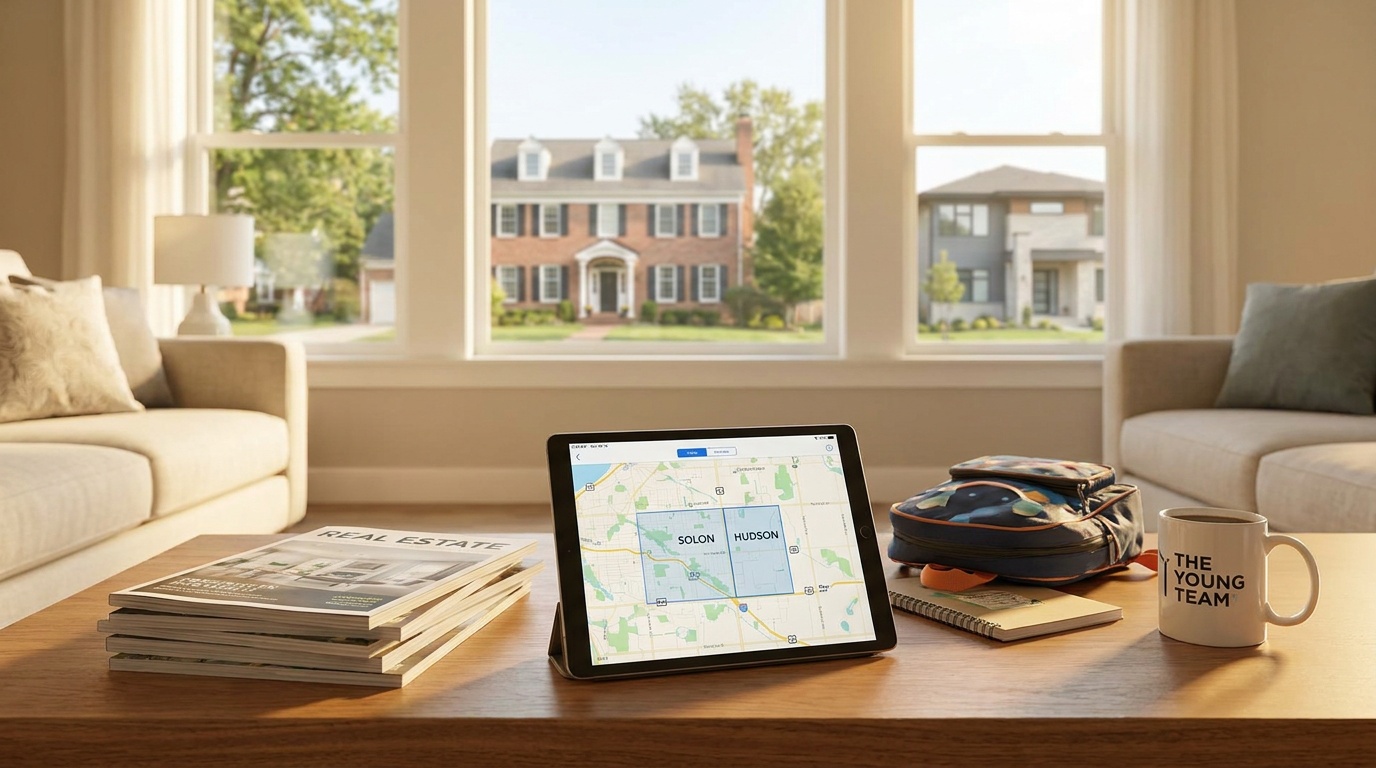
Solon vs. Hudson: The Northeast Ohio Suburb Battle for Families With Top-School Priorities in 2026
Solon vs. Hudson: The Five Key Differences for Families
- Median home prices differ by tier. Solon typically runs in the mid-to-upper $400K range for move-in-ready resale; Hudson's median sale price sits in the upper $500K–$600K+ range, reflecting strong school-district capitalization.
- Commute patterns split the decision. Solon favors east-side Cleveland corporate commuters (approximately 20–30 min); Hudson sits midway between Cleveland and Akron, working well for dual-income households with split employment anchors.
- Home style skews differently. Solon leans toward newer construction and planned subdivisions; Hudson offers a mix of resale colonials with a New England-style downtown core.
- Household income benchmarks are comparable. Both markets attract professional households — the budget ceiling, not the income floor, is what separates buyers.
- Rental inventory is limited in both markets. Owner-occupied rates run high in both communities; rental options exist but are constrained.
Solon vs. Hudson: Head-to-Head on Price, Schools, and Lifestyle
| Factor | Solon | Hudson |
|---|---|---|
| Median Sale Price | Mid-to-upper $400K range (verify current data) | Upper $500K–$600K+ range (verify current data) |
| School District Ranking | Consistently A+ statewide | Consistently top-tier statewide |
| School Sources | Niche: Solon City Schools | Public School Review: Hudson |
| Home Style Profile | Newer construction, planned subdivisions, 1980s–2010s builds | Resale colonials, split-levels, New England-style downtown |
| Commute to Cleveland | Approximately 20–30 min (east-side I-271 corridor) | Approximately 35–45 min |
| Commute to Akron | Approximately 40–50 min | Approximately 25–35 min |
| Median Days on Market | Data varies by season; pull current at Solon market report | Varies by season; pull current data before setting timeline |
| Median Home Size | Varies by subdivision | Varies; pull current data for target price band |
| Owner-Occupied Rate | High | High; Hudson skews strongly toward owner-occupants |
| Rental Availability | Limited | Limited |
| Downtown Character | Retail-oriented commercial areas | Walkable New England-style village center |
| Appreciation Signals | Historically steady; east-side Cuyahoga demand has supported consistent year-over-year value retention | Many observers note strong Summit County appreciation signals |
Both Niche's Ohio school district rankings and BestPlaces' Solon vs. Hudson comparison confirm that both communities deliver strong educational outcomes. The differentiators are cost of living, commute patterns, and lifestyle amenity profiles — not academic quality.
Many buyers find that comparable square footage in Hudson commands a meaningful premium over similar homes in Solon — a gap that represents real capitalization, not just neighborhood preference.
Cuyahoga and Summit County also carry different property tax structures, which affects long-term affordability beyond the purchase price. Before settling on a target price band, ask a lender familiar with both counties to model the full monthly payment — taxes included. This article does not provide tax advice; consult a CPA or qualified tax professional for guidance specific to your situation.
Which fits your family's priorities?
Hudson Deep Dive: Why This Community Commands a Premium
Hudson isn't expensive because of hype. The premium is structural, and understanding why it exists helps buyers evaluate whether it's worth paying.
The Downtown and Community Character
Hudson's downtown is a genuine village center with walkable retail, restaurants, and community gathering points that most suburban communities cannot replicate. The architecture and street layout have a New England character that feels distinct from the planned subdivisions that define much of suburban Northeast Ohio. For buyers who want a neighborhood that feels like a place, not a development, Hudson delivers that in a way Solon does not.
What the Prices Actually Reflect
Hudson's price points sit meaningfully above many comparable Northeast Ohio suburbs. Homes tend to move quickly, particularly well-priced, well-presented listings — a combination that signals constrained supply meeting persistent demand. Transaction history in the area shows that comparable homes in nearby communities command meaningfully less than their Hudson equivalents, and that gap reflects school-district capitalization, not coincidence.
Appreciation signals across Summit County have tracked strongly in recent years, with Hudson's above-median price points suggesting solid dollar-gain performance historically.
The Commute Advantage for Dual-Income Households
For a household where one partner commutes to downtown Cleveland and the other to Akron, Hudson's geographic position is a genuine operational advantage. At approximately 35–45 minutes to Cleveland and 25–35 minutes to Akron, neither commute is punishing. That flexibility is rare in a suburb that also delivers top-tier schools and strong resale demand.
Hudson's premium reflects not hype, but proximity, schools, and strong resale demand.
Solon Deep Dive: What Newer Construction Actually Means for Buyers
Solon is often categorized as the "more affordable" option, but that framing undersells what it actually delivers. The newer construction profile — predominantly 1980s through 2010s builds — translates into practical advantages that buyers sometimes overlook.
Lower Renovation Risk, Predictable Systems
Homes built in this era typically feature updated mechanicals, modern electrical panels, and layouts designed for open-concept living. Buyers are less likely to face the kind of deferred maintenance surprises that older resale colonials — common in Hudson — can carry. That means a smaller gap between purchase price and true move-in cost, which matters when your timeline is tight and your energy is already absorbed by a relocation.
HOA Structure and Maintenance Profiles
Many of Solon's planned subdivisions operate under HOA agreements that standardize exterior maintenance expectations and common area upkeep. That structure tends to produce consistent streetscape presentation and protects resale value over time. It also means predictable annual costs you can factor into your budget before you make an offer. Ask your agent to pull the specific HOA documents for any subdivision you're evaluating — the details vary meaningfully by community.
Access to the I-271 Corporate Corridor
Solon's location places buyers within approximately 20–30 minutes of the major employment concentrations along I-271: corporate parks in Beachwood, Woodmere, and Orange Village, as well as eastside medical campuses and professional services clusters. For a household where at least one partner works in that corridor, Solon's positioning removes commute friction entirely. You don't need Hudson's geographic midpoint advantage if your daily drive runs east on the same freeway.
East-side Cuyahoga County, including Solon, has historically supported consistent year-over-year value retention. Demand from buyers targeting the I-271 corridor has remained steady even during softer market periods, and Solon's school-district premium, while smaller than Hudson's, reflects real and durable buyer interest.
Seasonality and Market Timing
Solon's days-on-market data varies meaningfully by season and price band. Spring listings have historically moved faster than fall or winter inventory — but conditions shift. Pull current comparables from the Solon market report or ask The Young Team for live data before you set your timeline.
How to Test a Commute Before You Commit
Printed drive times are useful estimates. They are not what you'll actually experience at 7:45 on a Wednesday morning.
Before finalizing a target community, run a real commute test. Drive from a home you're seriously considering to your workplace during your normal departure window — not a Saturday afternoon, not a Google Maps estimate. Do it on a Tuesday or Wednesday, which typically reflect average weekday conditions better than Monday or Friday. If both partners work in different directions, each person should run the test independently.
Also test route variations. I-271 is the primary artery for east-side commuters, but surface streets through Chagrin Falls or Route 91 can shift meaningfully depending on construction or weather. Hudson commuters heading to Akron have additional options via Route 8, which can perform differently than I-77 at peak hours.
One test drive won't capture every scenario, but it will tell you whether the printed estimate is close to reality or significantly off. That information matters before you sign a purchase agreement, not after.
A Family Who Worked Through This Exact Decision
One family The Young Team worked with recently relocated from Chicago to Northeast Ohio for a corporate role based in Beachwood. They had two school-age children and started with Hudson at the top of their list — the downtown character and school reputation were exactly what they'd hoped for. After a market tour and a detailed commute analysis, the picture shifted. The daily drive from Hudson to Beachwood added 25 minutes each way compared to Solon, and the homes in their price range in Hudson needed meaningful updating. They purchased a 2004-built colonial in Solon in Solon City Schools, closed on schedule, and have since referred two colleagues to The Young Team.
Their situation isn't universal. A different family with one partner commuting to Akron might reach the opposite conclusion. The point isn't the outcome — it's the process of comparing real variables, not assumptions.
What Home Sellers Should Know Before Listing in Either Market
If you currently own in Solon or Hudson and are planning a move-up or relocation sale, velocity and positioning matter as much as price.
Hudson tends to see well-priced, well-presented homes move quickly, which signals that the market rewards precision in pricing and presentation. Solon's pace varies by season — spring tends to compress market time, while fall and winter inventory can sit longer. In both markets, pricing precision and presentation quality are the levers that separate fast sales from drawn-out ones.
The Young Team's Worry-Free Listing program lets you cancel your listing agreement at any time if the service isn't delivering. That structure exists because the relationship should be earned through results, not locked in by contract. For sellers who need to coordinate a sale before purchasing their next home, the Guaranteed Cash Offer program provides a verified offer you can accept or decline — certainty without obligation.
If you're evaluating listing timelines alongside a purchase in Solon or Hudson, ask the team to pull current absorption rates for your specific price band and home style. Those numbers vary more than city-level summaries suggest.
Why The Young Team Guides You Through This Decision
What an Online Search Won't Tell You
An online comparison between Solon and Hudson will get you the surface data. But it won't tell you which school zone a specific street falls in, whether the commute time on a printed map matches what actually happens at 7:45 on a Wednesday, or whether the homes available in your price band are actually move-in ready or require a renovation budget you haven't factored in.
Those questions require local expertise, not a search engine.
The Specialist Model That Makes the Difference
The Young Team has delivered a 6-star experience — not just satisfied, but genuinely delighted — across more than two decades and over a billion dollars in career sales in Northeast Ohio. That standard is reflected in 1,400-plus five-star reviews from forever clients across Cuyahoga, Summit, and the five other counties the team serves.
The team operates with a specialist model precisely because decisions this consequential require more than one person's knowledge. When a relocating family is evaluating Solon and Hudson simultaneously, your dedicated agent brings direct transaction experience in both markets. Your listing coordinator understands the inventory patterns specific to each community. Your closing coordinator has navigated the title, inspection, and contract processes in both counties.
That structure matters when you're making a six-figure decision on a tight timeline, often from out of state. The cost of picking the wrong school zone, underestimating a commute, or overpaying relative to comparable sales in either market is real and lasting. The team's role is to eliminate those risks through data and experience, not through guesswork.
For families working through a comparison like this one, our existing guide on Solon vs. Hudson vs. Brecksville adds a third market variable worth reviewing before you finalize your target community.
The Young Team: Your Northeast Ohio Relocation Experts
Choosing between Solon and Hudson is exactly the kind of decision The Young Team was built to support.
Founded in 2003 by Jeff and Terry Young, the team has spent more than two decades serving seven Northeast Ohio counties: Cuyahoga, Geauga, Lorain, Lake, Summit, Stark, and Portage. Career sales exceed $1 billion, and 1,400-plus five-star reviews reflect that standard in practice.
The specialist model is what makes that consistency possible. Every forever client receives a dedicated agent, listing coordinator, closing coordinator, and marketing specialist. No single person is responsible for everything, which means nothing gets dropped.
Three signature programs address the situations families most commonly face in a relocation:
- Guaranteed Cash Offer. If you need speed and certainty on a sale before you buy, the team presents a verified cash offer you can accept or decline. No obligation to take it — it's an option, not pressure.
- Worry-Free Listing. You can cancel your listing agreement anytime if the service isn't delivering. That structure exists because the team earns the relationship, not just signs it.
- Forever Client Care. After closing, the relationship continues. Vendor referrals, community connection, and future transaction support — because a relocation doesn't end at the closing table.
The team is based at Keller Williams Greater Metropolitan, and both Solon (Cuyahoga County) and Hudson (Summit County) fall squarely within the service area the team knows best. If school zones, market dynamics, and commute realities in these two communities are your questions, this team has the transaction data to answer them.
Solon vs. Hudson: Families Ask
Which town has better schools?
Both Solon City Schools and Hudson City Schools consistently rank among Ohio's top-performing districts. Niche's Ohio school district rankings place both in the top tier statewide, and Solon's district-specific data reflects strong college-readiness metrics, SAT/ACT performance, and advanced placement participation. Hudson's academic profile meets the same high bar. The difference between these districts is program emphasis, community character, and commute distance — not academic quality. If your priority is strong schools in Ohio, both qualify.
Is Hudson worth the higher price?
That depends on three variables: your commute, your home-style preference, and your resale goals. Hudson's price points sit meaningfully above comparable Northeast Ohio suburbs, and well-priced homes tend to move quickly — a combination that signals genuine demand. If one or both partners commute toward Akron, or if a New England-style downtown walkability profile matters to your daily life, the premium may align with your priorities. If your budget ceiling is lower or your commute anchors to Cleveland's east-side corporate corridor, Solon delivers equivalent school quality at a lower price point. This is a framework, not a recommendation — your specific numbers determine the answer.
How long do homes take to sell in each market?
Both Solon and Hudson see market velocity vary by price point and season. Spring inventory generally moves faster than fall and winter listings in both communities, but conditions shift. Pull current data at the Solon market report or ask The Young Team to pull live comps for your specific target. The team tracks this data by neighborhood, not just by city.
What's the commute really like?
Printed drive times are a starting point, not a guarantee. Solon's position along the I-271 corridor makes it efficient for east-side Cleveland corporate destinations — typically around 20–30 minutes under normal conditions. Hudson's midpoint location translates to approximately 35–45 minutes to downtown Cleveland and 25–35 minutes to Akron. In a dual-income household, Hudson's commute flexibility is a real operational advantage if both partners work in different directions. Actual drive times vary by exact employer location, departure time, and route. The team recommends doing a test drive during your intended commute window before finalizing a target community.
Ready to Compare Solon and Hudson in Person?
The data in this guide gives you a starting framework. The next step is a conversation about your specific situation: your commute, your price point, your school priorities, and what you actually want your daily life to look like.
The Young Team will walk both communities with you, pull current market data, and give you an honest comparison grounded in real transaction experience — not general market commentary.
Call us at 216-378-9618, email terryyoung@theyoungteam.com, or visit us at 34105 Chagrin Blvd, Suite L, Moreland Hills, OH 44022. You can also explore community resources and schedule a consultation at theyoungteam.com.
No pressure. Just data, local expertise, and a genuine conversation about what's right for your family.