
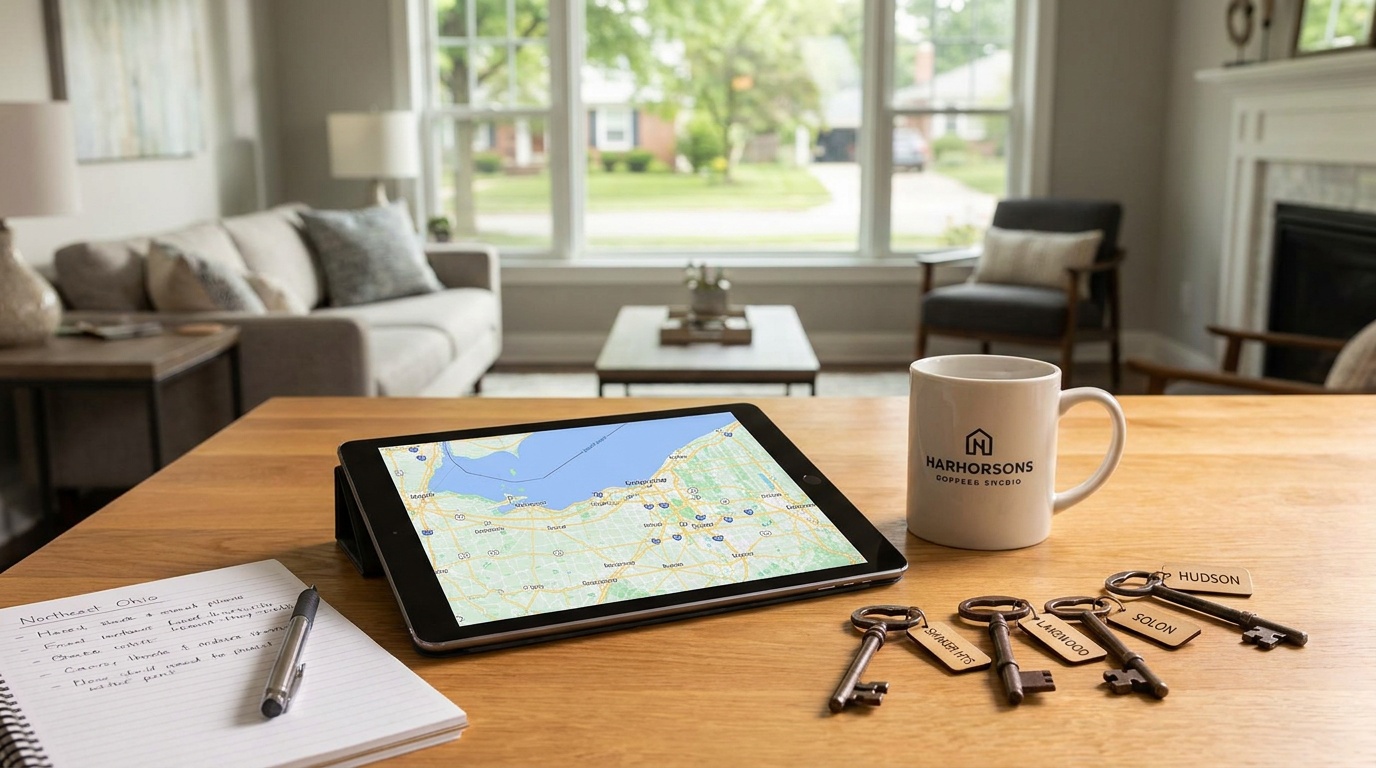
New to Northeast Ohio? Here's How Shaker Heights, Lakewood, Solon, and Hudson Stack Up in 2026
Four Suburbs, Four Lifestyles: A Quick Comparison
- Lakewood runs approximately $230K–$270K median and leads on walkability, with Detroit Avenue dining and Lake Erie access minutes from downtown Cleveland. If you're a first-time buyer or want to reduce car dependence, this is your entry point.
- Shaker Heights sits in the mid-$300Ks with RTA Rapid Transit access, landmark architecture, and proximity to University Circle. If you're commuting to the medical corridor or want transit options built into your daily routine, Shaker belongs on your list.
- Solon ranges approximately $350K–$400K with newer construction, larger lots, and a school district that consistently draws families relocating for academics. If schools are your first filter, Solon and Hudson are your starting conversation.
- Hudson prices are generally in the $400K range and above, with a walkable village center and access to both Akron and Cleveland job markets. If you want established community character and flexibility on commute direction, Hudson rewards the trade-off.
- Market speed varies significantly: inner-ring communities like Lakewood and Shaker tend to move faster; outer-ring markets like Solon and Hudson generally show more inventory and longer timelines.
- Property taxes differ meaningfully across these four communities. Ask your lender and a local CPA to factor total cost of ownership into every comparison.
Choosing Your Northeast Ohio Home: More Than Just Location
Picking a suburb in Northeast Ohio isn't just a real estate decision. It's a lifestyle decision, a school decision, a commute decision, and often a financial reset all wrapped into a single search.
Relocating professionals and move-up buyers frequently tell us the same thing: they open Zillow, see listings across Cuyahoga and Summit counties simultaneously, and immediately feel overwhelmed. A $380,000 budget pulls up results in Lakewood, Shaker Heights, Solon, and Hudson at the same time. The homes look different. The neighborhoods feel different. And without local context, it's nearly impossible to know which trade-off matters most for your household.
This article is a structured framework, not a verdict. Lakewood, Shaker Heights, Solon, and Hudson each serve a distinct buyer profile in 2026. The goal here is to give you the variables, the data, and the honest trade-offs so you can eliminate options quickly and focus your time on the communities that actually fit your priorities.
The Young Team serves all four markets, and we've worked with relocators, residency match recipients, and corporate transferees navigating exactly this comparison. What we've learned is that the right suburb becomes obvious once you're clear on four things: budget, commute, school priorities, and lifestyle preference. Let's walk through each community with that lens.
Lakewood: Affordability Meets Urban Walkability
If you're comparing Northeast Ohio suburbs and affordability is a primary variable, Lakewood belongs at the top of your list. According to Realtor.com's Lakewood market data, many buyers find median prices in Lakewood running in the mid-$200Ks, with the practical range for most buyers landing approximately between $230,000 and $270,000. That positions Lakewood as the most accessible entry point among the four communities in this comparison.
Lakewood sits directly west of Cleveland on Lake Erie, and the geography pays daily dividends. Downtown Cleveland and University Circle are accessible by car or by RTA bus along major corridors, with commute times typically ranging from 15 to 30 minutes from downtown Cleveland during morning peak, depending on route. For buyers commuting to Cleveland Clinic, University Hospitals, or downtown employers, Lakewood's location removes a significant portion of commute friction.
The community's walkability is a genuine differentiator. Detroit Avenue serves as the commercial spine, with independent restaurants, coffee shops, and retail concentrated in walkable clusters. Madison Avenue offers a quieter stretch of local shops and dining just blocks away. Lakewood Park sits directly on Lake Erie and draws residents year-round. The RTA bus network serves Lakewood's main corridors, which reduces car dependence for daily errands in a way that's uncommon in suburban Northeast Ohio.
Home styles skew older, with a mix of well-maintained brick colonials, bungalows, and two-family homes. Many have been renovated, though buyers should plan for a thorough inspection. Lakewood homes commonly surface updates needed in electrical systems, HVAC, and foundations during inspection. Older home stock often carries deferred maintenance items or mechanical updates that newer construction doesn't carry. You're buying character and location rather than new construction, and a diligent inspection protects that investment.
Lakewood City Schools serves the community's K-12 students. For independent verification of any district's academic performance, the Ohio School Report Cards site gives you current, official ratings without relying on third-party summaries.
For first-time buyers and move-up sellers who want to maximize equity purchasing power, Lakewood's price point and walkability combination is difficult to match anywhere in Cuyahoga County at this level. Homes here move quickly when priced and conditioned well, which means your offer strategy matters.
Shaker Heights: Architecture, Transit, and the Middle Ground
Shaker Heights occupies a distinct position in Northeast Ohio's suburban landscape: it delivers inner-ring access, transit infrastructure, and architectural character at a price point that sits between Lakewood's affordability and Solon or Hudson's premium range. According to Zillow's current home value data for Shaker Heights, typical home values sit in the mid-$300Ks, making it a compelling middle-ground option for buyers seeking character and transit access.
The built environment is the first thing buyers notice. Tree-canopied streets, Tudor revivals, center-hall colonials, and substantial brick homes on established lots give Shaker Heights a character that newer suburbs genuinely can't replicate. The streetscape itself signals permanence and investment.
Transit access is a practical advantage. The RTA Red Line and Green Line rapid transit corridors run through Shaker Heights, connecting residents to downtown Cleveland and University Circle without a car. The RTA system map shows the full picture, but practically speaking, this means a professional working at a Cleveland Clinic campus or a downtown employer can commute without relying on surface streets during peak hours. That matters for dual-income households managing two different commute directions. Shaker Square anchors the neighborhood's most walkable retail and dining node and serves as a gathering point for residents, adding a community-center quality that complements the transit access.
Shaker Heights City Schools has a national reputation that draws buyers from across the region and from out of state. Families relocating to Greater Cleveland frequently target Shaker specifically for its school system, walkable neighborhood character, and established standing. You can verify current district performance independently through Ohio School Report Cards.
Home styles in Shaker Heights lean heavily on period architecture, including Tudor revivals and center-hall colonials. Buyers should ask inspectors to evaluate roofing, original windows, and plumbing systems specifically, as deferred maintenance in these categories is common in homes of this era and can carry significant replacement costs.
Market speed in Shaker is competitive. Desirable properties with accurate pricing and solid condition move quickly, and inventory at the $350K to $450K range can be limited in any given month. If your search has narrowed to Shaker Heights and Lakewood specifically, we've published a deeper side-by-side breakdown worth reading before your first showing: Shaker Heights vs. Lakewood: Which Cleveland Suburb Fits Your Life in 2026?
Solon: Schools and New Construction in the Mid-Ring
Solon sits in the southeastern portion of Cuyahoga County, roughly 20 miles from downtown Cleveland, and it draws a specific buyer: move-up families who are prioritizing school quality, newer home stock, and lower residential density without leaving the metro area entirely.
According to Redfin's current Solon housing market data, median sale prices in Solon run from the mid-$300Ks into the low-$400Ks, putting the community in a comparable range to Shaker Heights but with a fundamentally different product mix. Where Shaker delivers character homes from the early and mid-20th century, Solon offers newer construction, larger square footage, and updated amenities. Lots are bigger. Floor plans are more contemporary. Buyers who prioritize move-in condition and modern layouts over architectural history tend to find Solon's inventory more directly aligned with their expectations.
Solon City Schools consistently ranks among Ohio's strongest districts. For current, official ratings, the Ohio School Report Cards is the authoritative source. School quality is typically the first filter for families with school-age children relocating from out of state, and Solon's district performance is a primary reason it appears on their shortlists.
Solon's commercial activity centers along Aurora Road and US-422, with retail, dining, and services accessible by car. This is a car-dependent community, and the trade-off for that density is newer home stock and quieter residential streets. Buyers coming from walkable cities should factor that trade-off in explicitly.
Newer construction in Solon still warrants a thorough inspection. Buyers should ask inspectors to pay particular attention to drainage systems, basement waterproofing, and HVAC performance given the age ranges of newer builds and regional weather demands.
Commute patterns from Solon work well for buyers with flexibility. The Twinsburg and Aurora corporate park corridors are close. Downtown Cleveland typically runs approximately 35 to 45 minutes from downtown Cleveland during morning peak conditions via I-271 and I-90, though actual times vary by route and traffic. Buyers managing dual-income households with different commute directions often find Solon's mid-ring position workable for both.
Market dynamics in Solon align with outer-ring patterns: more inventory than inner-ring communities, longer average days on market, and generally less multiple-offer pressure than Lakewood or Shaker. That shift in pace gives buyers more time to evaluate without compromising on quality.
Hudson: Village Charm with Dual-City Access
Hudson sits in Summit County, roughly 30 miles south of Cleveland and 15 miles north of Akron, and that geographic position shapes everything about who buys there. According to Zillow's Hudson home value data, many homes in Hudson are priced in the $400K range and above, with established neighborhoods often commanding meaningfully higher prices. This is the premium tier among the four communities in this comparison, and the product reflects it.
Hudson's downtown village center is a genuine amenity. The Village Green and Western Reserve Academy campus anchor a walkable historic core with pedestrian-scaled retail, independent restaurants, and preserved architecture. It's not urban walkability in the Lakewood sense, but it's a distinct alternative to the strip-mall suburban model. Parks, open spaces, and recreational trails extend the outdoor appeal across seasons.
Hudson City School District is among Summit County's strongest, and it draws buyers who are weighing academic profile alongside community character. As with every district in this comparison, Ohio School Report Cards gives you the official performance data.
The dual-city commute access is a genuine practical advantage for some households. Akron's downtown and medical corridor, including Summa Health and Akron Children's Hospital, are typically accessible in approximately 20 to 25 minutes from downtown Akron during normal conditions via SR-8 or SR-91. Cleveland runs approximately 40 to 50 minutes under typical morning peak conditions. For a household where one partner commutes north and the other commutes south, Hudson's position can solve what would otherwise be an unsolvable geographic problem.
Hudson's established homes typically feature well-maintained mechanicals, but buyers should ask inspectors to assess exterior wood and masonry, roofing age, and any deferred landscaping or drainage work on larger lots, which can carry meaningful remediation costs.
Market dynamics in Hudson follow outer-ring patterns. Inventory builds more slowly than inner-ring communities, timelines are longer, and buyers generally have more negotiating room than they would in Lakewood or Shaker. The housing stock is established and consistently maintained, with most homes reflecting decades of community investment.
A Note on Property Taxes
Property taxes in Northeast Ohio vary more than most out-of-state buyers expect, and they can shift the real cost of ownership significantly between communities that appear close in purchase price.
To give you a directional sense of scale: effective property tax rates in Cuyahoga County communities like Lakewood and Shaker Heights are often cited in the range of approximately 2.0% to 2.5% of assessed value, while Solon, also in Cuyahoga County, may run somewhat lower depending on the school district levy structure. Hudson, in Summit County, historically carries a different rate structure that can be meaningfully lower than Cuyahoga County communities at comparable purchase prices. These figures are illustrative and shift based on levies, exemptions, and assessed value calculations. Verify current rates with a local CPA and your lender before finalizing any comparison.
The practical impact: two homes with identical purchase prices in different communities can carry meaningfully different monthly obligations once taxes are factored in. For relocating professionals accustomed to lower-rate states, even Lakewood's entry price point can carry a higher total cost than the list price suggests. Shaker Heights and Hudson communities often include HOA fees as well; budget those into your total cost of ownership calculation alongside taxes.
The Young Team recommends connecting with a local CPA and your lender to run total cost of ownership numbers before finalizing your community shortlist. We can provide referrals to trusted local professionals.
What It Looks Like in Practice: A Relocator's Story
One of our recent forever clients, a healthcare operations professional relocating from the mid-Atlantic, came to us with a clear priority list: top schools, reasonable commute to a Cleveland Clinic campus, and a home in move-in condition. She assumed Solon was the obvious answer.
After mapping her actual commute direction and daily schedule, it turned out Shaker Heights cut her drive time by nearly 15 minutes each way and put her on the RTA Rapid Transit line when she needed flexibility. The school comparison was closer than she expected. Her offer on a center-hall colonial in Shaker accepted within a week of her landing in Cleveland for her first in-person visit. She's been a forever client since closing, and her first call for a contractor referral came three weeks after keys.
That outcome didn't happen because we knew her preferred suburbs. It happened because we mapped her actual priorities, her real commute path, and her inspection concerns before she ever stepped into a showing.
Relocating on a Compressed Timeline? Here's the Strategy
Out-of-state buyers frequently arrive with 45 to 90 days from decision to close. That compressed timeline changes the strategy for each suburb.
Lakewood moves fast. If you're targeting this market on a short timeline, you'll need pre-approval locked before your first visit, an offer framework ready to move same-day or next-day after a showing, and an inspector who can turn around a report in 48 hours or less. The pace here is unforgiving for buyers who need more than a weekend to decide.
Shaker Heights requires community-specific knowledge to move efficiently. Not all blocks trade at the same pace. Knowing which streets have seen recent activity and which price bands have inventory constraints lets you focus your limited visit days rather than touring broadly. A compressed timeline in Shaker rewards preparation over exploration.
Solon and Hudson give relocators more room. Inventory tends to be higher, and the market generally allows for a second showing trip before an offer. For buyers with a 60-day window, that extra evaluation time matters. Outer-ring logistics still add complexity for remote buyers managing out-of-state timelines, which is where the team's specialist model removes friction most visibly.
The Young Team's specialist model is built for exactly this scenario. A dedicated agent handles your search and local strategy. A closing coordinator manages the transaction pipeline so nothing falls between accepted offer and closing day. That division of responsibility means your agent's full attention stays on your search, not on paperwork, even when the clock is tight.
Side-by-Side: How the Four Stack Up
| Category | Lakewood | Shaker Heights | Solon | Hudson |
|---|---|---|---|---|
| Median Price | ~$230K–$270K | Mid-$300Ks | ~$350K–$400K | $400K+ |
| Primary Buyer Profile | First-time buyers, downtown commuters, walkability seekers | Professionals, transit riders, school-driven families | Move-up families, school-priority buyers, dual-income households | Established families, dual-city commuters, village lifestyle buyers |
| School District | Lakewood City Schools | Shaker Heights City Schools (national reputation) | Solon City Schools (top Ohio ranking) | Hudson City Schools (Summit County leader) |
| Top Commute Destinations | Downtown Cleveland and University Circle (15–30 min typical, morning peak) | Downtown Cleveland via RTA Rapid Transit, University Circle | Twinsburg/Aurora corporate parks (15–20 min), Cleveland (35–45 min typical, morning peak) | Akron (20–25 min typical), Cleveland (40–50 min typical, morning peak) |
| Walkability/Transit | High walkability, RTA bus corridors | High walkability, RTA Rapid Transit (Red/Green Lines), Shaker Square | Suburban, car-dependent | Walkable village center and Village Green, car-dependent for broader commutes |
| Home Style Mix | Older bungalows, colonials, brick character homes | Tudor revivals, center-hall colonials, large established lots | Newer construction, contemporary floor plans, larger lots | Established homes, varied styles, generous lots |
| Market Speed | Fast, competitive at entry price point | Competitive, limited inventory in mid-range | Slower, more inventory than inner-ring | Slower, buyer has more evaluation time |
| Key Inspection Focus | Electrical, HVAC, foundations | Roofing, original windows, plumbing | Drainage, basement waterproofing, HVAC | Exterior wood/masonry, roofing age, lot drainage |
| Best Fit If You Prioritize | Affordability and walkability | Transit access and architectural character | Schools and newer construction | Village lifestyle and dual-city commute flexibility |
All commute estimates reflect typical morning peak conditions and vary by route, departure time, and traffic. For independent verification of school district performance across all four communities, use the Ohio School Report Cards.
Why The Young Team Works Across All Four Markets
These four communities don't behave the same way. A buyer moving from out of state often discovers that quickly, sometimes mid-transaction.
Lakewood's pace is compressed. Competitive offers sometimes need to move within hours of a showing. Shaker's inventory is tight in specific price bands, and knowing which blocks are most actively traded matters. Solon and Hudson give buyers more time, but outer-ring logistics add complexity for relocators who are still managing timelines from another state. The market intelligence required to navigate each community isn't interchangeable.
The Young Team's specialist model exists specifically for this variability. A dedicated agent handles the client relationship and local strategy. A listing coordinator and closing coordinator manage the transaction pipeline so nothing falls through between accepted offer and closing day. A marketing specialist ensures that for clients selling in one market to buy in another, the outbound presentation is as sharp as the inbound search.
Three signature programs make the experience measurably different for relocators. The Guaranteed Cash Offer removes the contingency risk that can stall or derail a transaction when you're selling in one market to buy in another. If your offer on a Northeast Ohio home is contingent on selling your current home out of state, that contingency can cost you the deal in a competitive market. The Guaranteed Cash Offer gives you a path to remove it. The Worry-Free Listing gives sellers a structured, supported path to market without the scramble. Forever Client Care keeps the team in your corner well past closing day, with contractor referrals, school enrollment timing guidance, and ongoing market context for your first year as a Northeast Ohio resident. For out-of-state buyers who arrive without a local network, that ongoing support is often what makes the difference between feeling settled and feeling stranded.
The bar we hold ourselves to is a 6-star experience, which means beyond satisfied, into genuinely delighted. Not five stars. Six. That standard is what 1,400-plus forever clients have verified publicly across more than two decades and $1 billion in career sales. The Young Team has served Northeast Ohio buyers and sellers continuously since 2003, across Cuyahoga, Geauga, Lorain, Lake, Summit, Stark, and Portage counties. Whether your search lands in Lakewood or Hudson, you're working with agents who know that specific market.
The team operates at Keller Williams Greater Metropolitan, with an office at 34105 Chagrin Blvd, Suite L, Moreland Hills, OH 44022.
After You Close: What Forever Client Care Looks Like
The relationship with The Young Team doesn't end at the closing table. Forever Client Care is the team's commitment to staying in your corner through your first year as a Northeast Ohio resident and beyond.
In practice, that means contractor referrals when you need a reliable HVAC technician or roofer in an unfamiliar city. It means school enrollment timing guidance when the academic calendar moves faster than you expected. It means a call when you have a question about your property tax assessment and need to know whether an appeal makes sense. And it means honest market updates when you start wondering what your home is worth two or three years out.
For buyers relocating from out of state, this ongoing connection fills a real gap. Most people who move to a new city spend their first year assembling a local network from scratch. Forever Client Care compresses that process significantly.
Common Questions from Northeast Ohio Relocators
Which suburb is best for families with school-age children?
It depends on what you mean by best. Solon and Hudson both lead on standardized academic performance and draw buyers specifically for that reason. Shaker Heights City Schools carries a national reputation and the added benefit of urban walkability and transit access. Each district has a distinct profile. The Ohio School Report Cards gives you current, official performance data for every district mentioned here. The Young Team can help you map your family's academic priorities to the district that actually fits, rather than working from reputation alone.
How fast do homes sell in these suburbs?
Market speed varies significantly across these four communities. Lakewood moves fast, particularly at the entry price point, where demand from first-time buyers and downtown commuters keeps well-conditioned homes competitive. Shaker Heights is similarly competitive in its desirable price bands, with limited inventory at the mid-range. Solon and Hudson follow outer-ring patterns, with more available inventory and longer average days on market, giving buyers more time to evaluate without the same multiple-offer pressure common in the inner ring. Condition and accurate pricing matter in every market, regardless of speed.
What's the typical commute from each suburb to downtown Cleveland?
Lakewood is accessible to downtown Cleveland by car or by RTA bus along major corridors, with commute times typically ranging from 15 to 30 minutes during morning peak depending on route. Shaker Heights connects to downtown and University Circle via RTA Rapid Transit, and the RTA system map shows full route detail. Solon typically runs approximately 35 to 45 minutes to downtown Cleveland during morning peak by car via I-271 and I-90, depending on conditions. Hudson typically runs approximately 40 to 50 minutes to Cleveland and 20 to 25 minutes to Akron during morning peak, making it the strongest option for households managing dual-city commutes in opposite directions. All estimates reflect historical patterns under typical morning conditions and will vary.
Can you help with out-of-state logistics?
Yes. The Young Team works with relocating professionals regularly, including corporate transferees, residency match recipients, and buyers managing out-of-state timelines with limited visit windows. The team's specialist model means you're never coordinating through a single agent who's also handling transaction paperwork, showing logistics, and marketing simultaneously. Forever Client Care continues the relationship after closing, which is particularly valuable for buyers who arrive without a local network and need contractor referrals, school enrollment guidance, or market context in their first year.
How do you price homes differently across these four markets?
Each community requires its own comparable market analysis, drawn from recent sales in the specific neighborhood and price band relevant to your home. A colonial in Shaker Heights doesn't compare to a newer build in Solon; the market data, buyer pool, and competitive set are different. The Young Team's approach is to use current, localized data, not countywide averages, to establish accurate pricing that reflects condition, location, and the specific demand profile of each community. Historical data signals that overpricing in any of these markets leads to longer market time and eventual price reductions.
What should I know about property taxes across these communities?
Property taxes vary meaningfully across Lakewood, Shaker Heights, Solon, and Hudson, and they affect your total monthly cost of ownership in ways that the purchase price alone doesn't capture. For relocating professionals moving from other states, even the lower-rate suburbs in Cuyahoga County may represent a higher effective rate than you paid previously. The Young Team recommends connecting with a local CPA and your lender to run total cost of ownership numbers before finalizing your community shortlist. We can provide referrals to trusted local professionals.
Ready to Find Your Northeast Ohio Home?
If you're comparing Lakewood, Shaker Heights, Solon, and Hudson and want a structured conversation about which community fits your budget, commute, and priorities, The Young Team is ready to help.
Schedule a no-pressure consultation to walk through your specific situation and get an honest read on which suburb makes the most sense for your household.
Call or text: 216-378-9618 Email: terryyoung@theyoungteam.com Visit: 34105 Chagrin Blvd, Suite L, Moreland Hills, OH 44022 Explore: theyoungteam.com